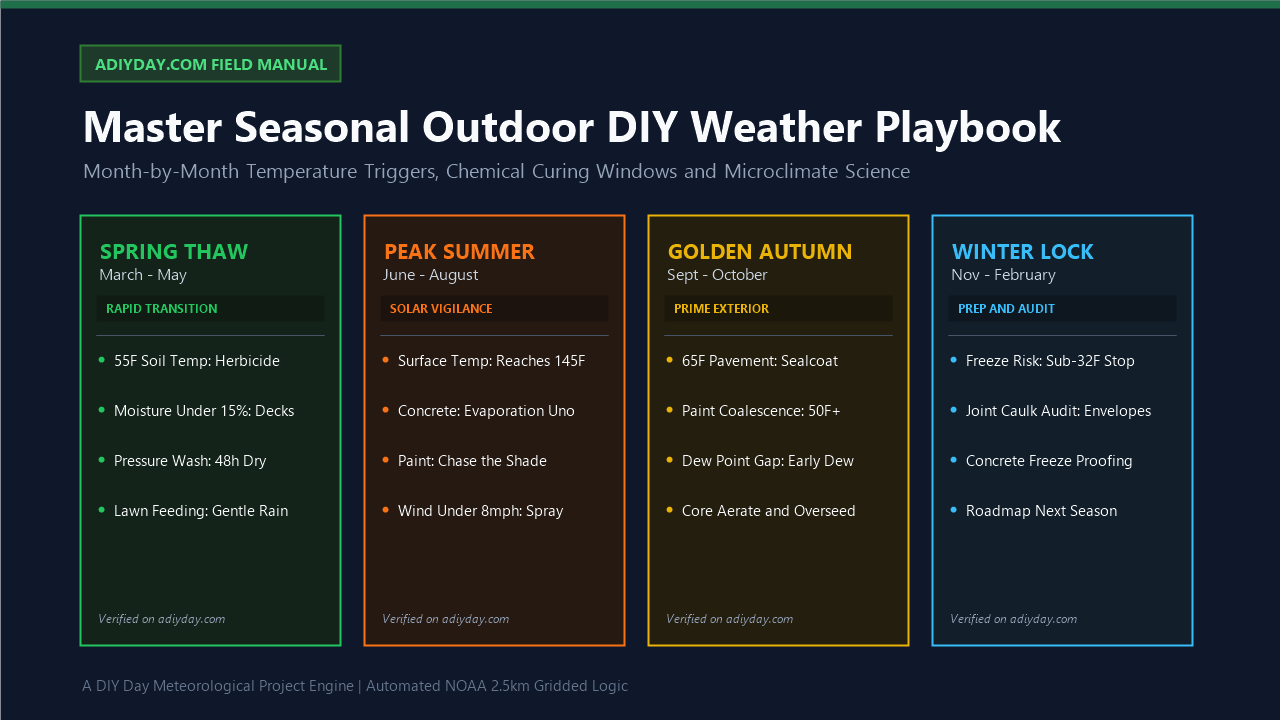
1. The Seasonal Paradigm Shift: Why Calendar Dates Lie and Only Thermal Triggers Work
Every year, millions of homeowners wake up on a balmy Saturday in late March or early April, smell the spring breeze, see the thermometer register 65°F (18.3°C), and rush out to buy materials. They buy gallons of penetrating deck stain, bags of turf fertilizer, jugs of pre-emergent weed killer, or buckets of asphalt driveway sealer. By June, that same deck is flaking off in ugly ribbons, crabgrass is choking the lawn, and the driveway sealer is peeling away in greasy patches.
What went wrong? The homeowner relied on a calendar date and a single midday ambient air temperature reading. They assumed that because it felt pleasant outside, conditions were primed for complex architectural chemistry. In reality, modern building materials and biological turfgrass systems do not react to human comfort. They respond to four strict thermodynamic triggers:
- Thermal Inertia of Mass: Air heats up and cools down rapidly. Ground soil, concrete slabs, and thick structural lumber possess immense thermal mass. In early spring, a 68°F afternoon sun can shine down on soil that is still a frigid 44°F, or on deck boards holding 25% internal water content from melted winter snowpack.
- Chemical Activation Energy ($E_a$): Acrylic latex polymer cross-linking, two-part amine epoxy resin hardening, and asphalt emulsion coalescence require specific thermodynamic energy floors. Below their critical minimum temperatures (e.g., 50°F for standard latex paint, 60°F for epoxy, 65°F for asphalt emulsion), curing kinetics decelerate to near zero. The carrier evaporates without forming continuous polymer chains, leaving a crumbly, unbonded film.
- Biological Phenology & Soil Temperature: Weed seeds do not consult calendars; they germinate when cumulative soil heat units reach physiological thresholds. Applying lawn care products based on the calendar rather than soil thermometers wastes 100% of your chemical investment.
- Seasonal Sun Angle & Dew Point Compression: The sun's angle above the horizon dictates how quickly horizontal surfaces radiate heat into the atmosphere. A 60°F afternoon in June allows five full hours of curing after 4:00 PM; a 60°F afternoon in October plunges into heavy condensation and dew point collapse by 5:15 PM, liquefying uncured coatings.
To succeed as a weekend DIYer, you must shift your mindset from "What month is it?" to "What do the thermodynamic triggers and hourly weather models say?" This master field manual details the seasonal rhythm of exterior home maintenance, highlighting the scientific indicators that govern every project supported by the A DIY Day (adiyday.com) project forecasting engine.
2. Early Spring (Late February – April): The Thaw, Soil Awakening & The Lumber Moisture Trap
Early spring is characterized by volatile atmospheric transitions. Polar air masses clash with warm Gulf moisture, creating rapid barometric swings, high winds, and erratic temperature rollercoasters. It is also the season where DIYers commit the most expensive mistakes.
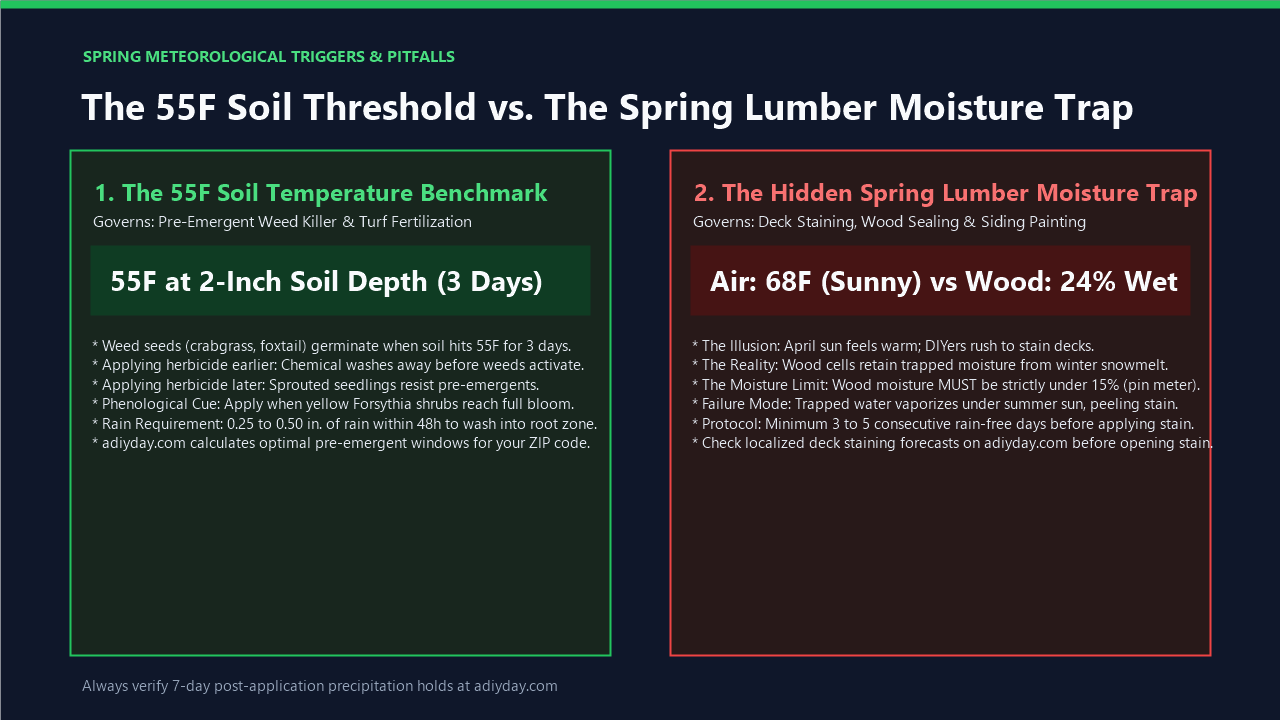
The 55°F Soil Temperature Benchmark (Lawn Care & Weed Prevention)
The single most time-sensitive DIY task of the entire year occurs in early spring: applying pre-emergent herbicide to prevent crabgrass (Digitaria), goosegrass, and foxtail. Pre-emergent herbicides (such as prodiamine, dithiopyr, or pendimethalin) do not kill growing weeds; they form a microscopic vapor barrier in the top half-inch of soil that inhibits root cell division as weed seeds germinate.
The biological trigger is precise: crabgrass seeds germinate when soil temperature at a 2-inch depth reaches 55°F (12.8°C) for three to four consecutive days.
- The "Too Early" Penalty: If you apply pre-emergent in February or early March when soil is 42°F, microbial activity and heavy spring rains will wash the active barrier below the germination zone weeks before the first seed sprouts, leaving your lawn completely unprotected by May.
- The "Too Late" Penalty: If you wait until early May when dandelions are in full white puffball stage, soil temperatures have likely hovered at 62°F–65°F for two weeks. Crabgrass seedlings have already developed their primary root system and are immune to pre-emergents.
- The Phenological Indicator: Nature provides an exquisite visual benchmark. When bright yellow Forsythia bushes reach peak full bloom in your neighborhood, soil temperatures are entering the 52°F to 55°F window. When Forsythia blossoms begin dropping their petals and green leaves appear, your pre-emergent window is closing.
- Precipitation Coupling: Pre-emergents must be watered into the top 1–2 inches of soil within 48 hours to activate. Check Can I Spray Weed Killer Today? on ADiyDay to ensure a 0.25 to 0.50-inch gentle rain window is incoming, without torrential downpours that cause soil erosion.
The Hidden Spring Lumber Moisture Trap (Why Spring Deck Staining Fails)
The number one source of angry emails received by exterior paint and stain manufacturers involves decks stained in April that peel off by July. Homeowners argue: "The weather was 70°F and sunny all weekend! The wood looked completely dry!"
Here lies the physics trap. Wood is a hygroscopic, cellular sponge. Throughout the winter, outdoor decks absorb snowpack, freezing rain, and high ambient humidity. In March and April, the outer 1/32nd of an inch of wood can dry in the sun within four hours, appearing pale and thirsty. But deep within the cellular tracheids, internal moisture content often registers between 22% and 30%.
Penetrating oil and waterborne acrylic deck stains require wood moisture content strictly below 15% (verified with a digital pin-type moisture meter). If you coat wood containing 24% moisture:
- The viscous stain cannot penetrate the saturated cellular cavities and is forced to dry as an unanchored surface skin.
- As summer arrives and direct solar irradiance heats the deck boards to 125°F–140°F, the trapped deep water converts to water vapor.
- The expanding water vapor generates intense hydrostatic pressure, blowing the stain right off the wood fibers from the inside out.
The Spring Rule: Reserve early spring for inspection, gentle cleaning, and replacing rotted boards. Postpone all deck staining until late spring after at least four to five consecutive days of warm, rain-free weather have allowed deep wood fibers to desiccate below 15%. Track your exact regional readiness on Can I Stain My Deck Today?.
Spring Pressure Washing Protocols
Early spring is ideal for pressure washing winter grime, moss, and mildew from siding, concrete walkways, and stone patios. However, you must observe two meteorological safeguards:
- The 36°F Overnight Hold: Never pressure wash porous masonry, brick, or unsealed concrete if overnight temperatures will drop below 32°F (0°C). Water driven deep into capillaries under 2,500 psi will freeze and expand by 9%, causing catastrophic spalling and micro-cracking.
- The Subsequent Drying Window: If you are pressure washing as prep for painting or caulking, verify on Can I Pressure Wash Today? that a 48 to 72-hour dry window follows your washing session.
3. Late Spring to Early Summer (May – June): The Prime Renovation Window
Late spring and early summer represent the premier exterior renovation window across North America. Ambient air temperatures stabilize between 65°F and 80°F, frost threats vanish, and daylight hours expand toward the summer solstice. However, early summer brings its own unique obstacles: airborne pollen blooms and rapid humidity surges.
The "Goldilocks Zone" for Garage Floor Epoxy
Applying a two-part 100% solids epoxy or polycuramine coating to a garage floor is the most chemically demanding DIY project a homeowner can undertake. Epoxies demand tight environmental control across three distinct metrics: slab temperature, ambient relative humidity, and moisture vapor emission.
- Concrete Thermal Mass: Unheated concrete slabs lag ambient air by weeks. In early May, outside air might hit 72°F, but the slab resting on cold ground remains 52°F. Epoxies require a minimum slab temperature of 55°F to 60°F (measured with an infrared thermometer). If applied to a cold slab, the base resin and polyamide/amine hardener fail to cross-link exothermically, staying tacky indefinitely.
- The Humidity & Amine Blush Hazard: In mid-summer, high humidity (>80%) causes curing amines to react with atmospheric water vapor and carbon dioxide. This produces a greasy, milky carbamate salt known as amine blushing that ruins the gloss and causes topcoat peeling. Late May through early June offers the ultimate sweet spot: warm slabs without oppressive tropical humidity.
- Forecast Verification: Always monitor your 7-day cure horizon at Can I Epoxy My Garage Floor Today?.
Deck Staining & The Pollen Hazard
Late spring is prime deck restoration season. The wood has finally dried below 15% moisture content, and temperatures are warm enough to encourage rapid solvent evaporation. But homeowners must beware the pollen bloom.
When pine, oak, and birch trees release heavy yellow pollen clouds in May, airborne pollen grains settle into wet, tacky stain films. The pollen grains become permanently sealed into the coating, producing a rough sandpaper texture, dulling the luster, and providing an organic nutrient source for mold spores. Always rinse pollen off your deck, let it dry for 48 hours, and choose a low-wind day with moderate pollen counts before applying your finish.
Exterior Caulking & Joint Sealing
Late spring is the ideal season to inspect and replace failed exterior caulk along window frames, door perimeters, corner boards, and masonry expansion joints. Because caulk accommodates building movement through expansion and contraction, applying it when ambient temperatures are in the 60°F to 75°F range places the sealant bead in a neutral mechanical state. See Can I Caulk Outside Today? for real-time wind and rainfast checks.
4. Mid-to-Late Summer (July – August): High-Heat Dynamics, Solar Gain & Shade Chasing
Mid-summer presents a paradox. While rain probability is often low and daylight is abundant, high ambient heat, extreme solar radiation, and rapid evaporation introduce severe chemical failure mechanisms that catch unsuspecting homeowners off guard.
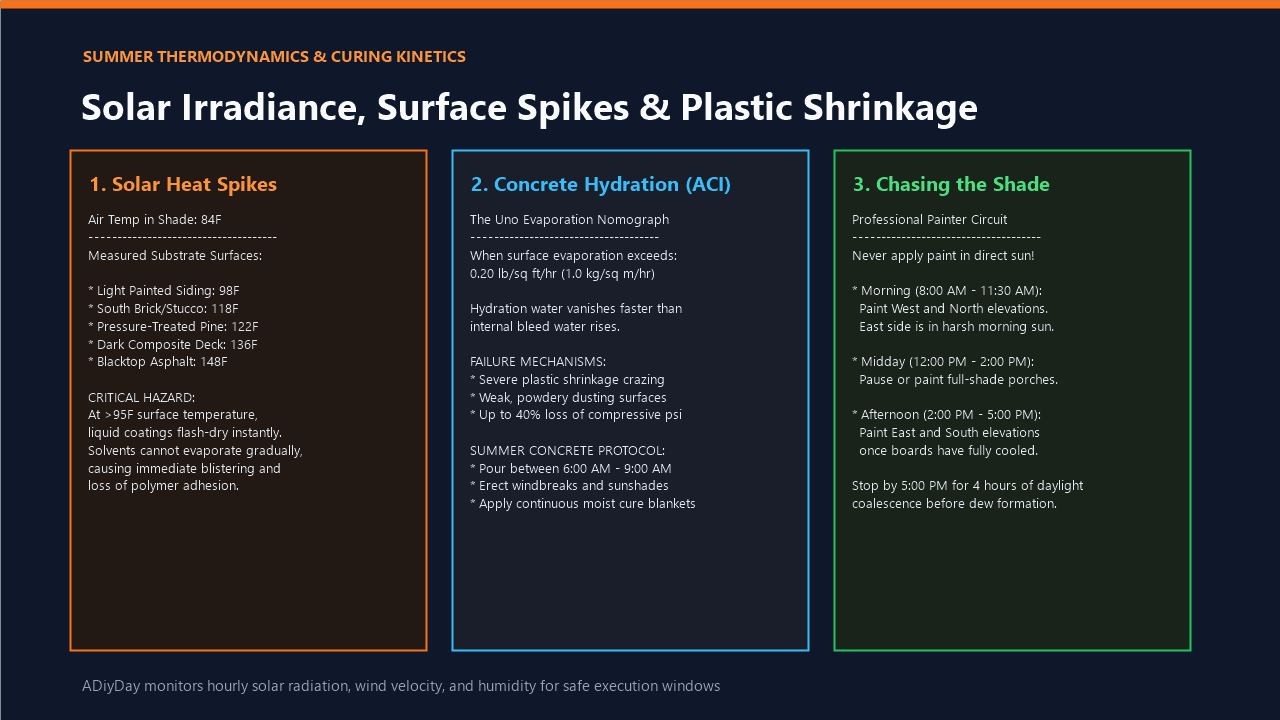
Solar Gain & The Flash-Drying Phenomenon
Weather forecasts measure ambient air temperature in deep shade, six feet off the turf. But building substrates live in the direct path of unfiltered solar irradiance. The disparity between air temperature and substrate temperature during July and August is dramatic:
| Substrate Surface | Ambient Air (Shade) | Direct Midday Sun Temperature | Impact on DIY Coatings |
|---|---|---|---|
| Light-Colored Vinyl / Wood Siding | 84°F (28.9°C) | 98°F – 105°F | Acceptable with open-time extenders; borderline for dark paint. |
| Red Brick / Dark Stucco | 84°F (28.9°C) | 115°F – 125°F | Severe risk: paint skins over in seconds, trapping volatile solvents. |
| Pressure-Treated Pine Deck | 84°F (28.9°C) | 120°F – 130°F | Extreme flash drying; stain cannot penetrate wood cell lumens. |
| Dark Composite Decking | 84°F (28.9°C) | 135°F – 148°F | Dangerous to touch; synthetic polymers warp and release heat. |
| Blacktop Asphalt Driveway | 84°F (28.9°C) | 145°F – 160°F | Sealer boils on contact, creating microscopic blisters and pinholes. |
When you brush or roll paint, stain, or sealer onto a surface hotter than 95°F (35°C), the volatile liquid carrier boils off instantly. The top layer of resin cross-links into a skin before the lower layer can wet the substrate. As the trapped underlying solvents eventually heat up and vaporize, they push upward through the cured skin, forming hundreds of tiny blisters and craters that peel within months.
The Professional "Chase the Shade" Circuit
Professional exterior painters never work in direct midday sunlight during mid-summer. Instead, they operate on a rotating geographic compass around the home:
- Morning (8:00 AM – 11:30 AM): Work the West and North elevations of the home. These walls remain cool in the morning shadow while the East elevation is scorched by the rising sun.
- Midday (12:00 PM – 1:30 PM): Take a break or paint under covered porches and soffits where indirect airflow keeps surfaces below 85°F.
- Afternoon (2:00 PM – 5:30 PM): Transition to the East and South elevations once the sun has passed overhead and the siding has radiated away its peak thermal load.
- The 5:30 PM Hard Stop: Even in summer, cease painting three to four hours before sunset so the acrylic film can fully coalesce before evening dew point compression begins. Review daily paint safety on Can I Paint Outside Today?.
Summer Concrete Pours & The Uno Evaporation Equation (ACI 305R)
Pouring a concrete patio, driveway apron, or equipment pad during July or August requires fighting the atmospheric rate of surface evaporation. Concrete does not harden by drying; it gains compressive strength through hydration—a continuous chemical crystallization between Portland cement particles and water.
Under the guidelines of the American Concrete Institute (ACI 305R - Guide to Hot Weather Concreting), when the evaporation rate of surface bleed water exceeds 0.20 lb/ft²/hr (1.0 kg/m²/hr), severe plastic shrinkage cracking occurs. At this threshold, moisture evaporates from the surface faster than internal bleed water can rise to replace it. The unhydrated surface matrix tears apart in wide, jagged cracks.
The ADiyDay calculation engine continually computes the Uno evaporation equation using hourly solar radiation, wind speed, relative humidity, and air temperature. When planning a summer pour, follow these rules:
- Schedule concrete ready-mix trucks for 6:00 AM to 7:30 AM to finish floating before peak midday solar heat arrives.
- Erect temporary windbreaks and shade tarps over the slab.
- Apply a continuous wet-cure with soaker hoses and burlap blankets for a minimum of seven days. Plan your pour window on Can I Pour Concrete Today?.
Exterior Spray Painting Windows
Summer is popular for restoring patio furniture, wrought iron railings, and metal gates with aerosol enamel or HVLP sprayers. Spray painting requires ambient winds strictly under 8 mph. In summer, thermal updrafts create unpredictable afternoon gustiness. Furthermore, rapidly expanding propellants cause severe temperature drops in atomized droplets; if relative humidity exceeds 75%, condensation forms inside the droplets, clouding the finish. Verify wind and humidity ceilings at Can I Spray Paint Outside Today?.
5. Early Autumn (September – October): The Prime Exterior Window & The Dew Point Squeeze
For professional contractors, September and early October represent the undisputed "Golden Window" of the home improvement calendar. Thunderstorm activity collapses, ambient temperatures moderate, UV index drops, and humidity levels decline. However, autumn presents a dangerous meteorological trap: the early dew point squeeze.
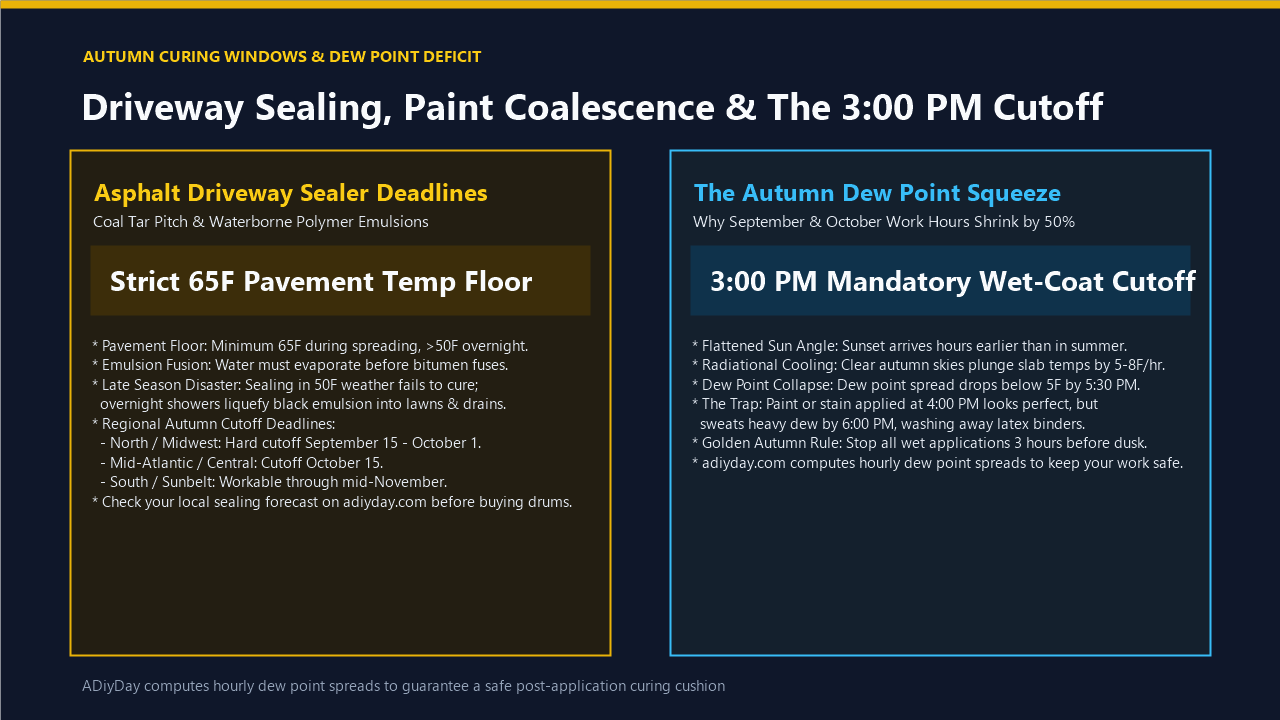
The Autumn Dew Point Squeeze & The 3:00 PM Cutoff
In July, sunset occurs around 8:45 PM, and the atmosphere retains heat well past twilight. In October, sunset occurs before 6:30 PM, and the low solar angle delivers minimal radiative warmth after 4:00 PM.
Under clear autumn skies, horizontal surfaces (roofs, decks, concrete, freshly painted siding) radiate heat outward into the vacuum of space at rates of 5°F to 8°F per hour after 4:00 PM. This rapid radiational cooling causes the substrate surface temperature to crash into the ambient dew point by 5:30 PM. The dew point spread narrows to zero, and thick, microscopic liquid condensation drenches the surface.
The Disaster: If you apply paint or deck stain at 4:30 PM, it will look magnificent when you pack your ladder into the garage. But two hours later, before the latex or oil film has formed a rainfast skin, heavy dew will coat the boards. Water-soluble surfactants are pulled to the surface, latex resin binders are diluted, and the coating turns into a sticky, washed-out milky mess that will never cure properly.
The Golden Autumn Rule: In September and October, cease all wet coating applications by 2:30 PM to 3:00 PM. Give your materials a mandatory three to four-hour thermal buffer of daylight curing before the evening dew point compression arrives.
The Hard Fall Deadline for Asphalt Driveway Sealing
Asphalt driveway sealers (whether coal tar, asphalt emulsion, or acrylic hybrid) are waterborne colloidal suspensions. To cure into a tough, jet-black, fuel-resistant barrier, every molecule of water must evaporate, allowing microscopic bitumen droplets to fuse together.
- The Thermal Floor: Driveway sealers require a minimum pavement surface temperature of 65°F (18.3°C) during application, and ambient air temperatures must remain above 50°F (10°C) continuously for the first 24 to 48 hours.
- The Late Season Catastrophe: In late October or November, when ambient air is 54°F and nights drop into the 30s, the emulsion cannot fuse. If an unpredicted shower hits an uncured driveway, thousands of dollars of black bitumen wash directly off the driveway into your lawn, landscaping, and municipal storm sewer, creating an expensive environmental cleanup hazard.
- Regional Autumn Cutoffs: In the Northern U.S. and Midwest, driveway sealing must conclude by September 15 to October 1. In the Mid-Atlantic, conclude by October 15. In the Deep South and Desert Southwest, work remains viable through mid-November. Always verify your local pavement window on Can I Seal My Driveway Today?.
Fall Lawn Aeration, Overseeding & Root Nutrition
September is the absolute premier month for cool-season lawn restoration (Kentucky bluegrass, perennial ryegrass, tall fescue). Core aeration relieves compacted soil, while overseeding introduces robust modern grass varieties.
- Soil Temperature Sweet Spot: Grass seed germinates best when soil temperatures range between 55°F and 65°F (corresponding to daytime air temperatures of 68°F–78°F). Seed germinates twice as fast in warm autumn soil as it does in cold spring mud.
- Fall Starter Fertilizer: Apply high-phosphorus and potassium fall fertilizer to encourage deep root elongation before ground freeze. Check Can I Fertilize My Lawn Today? to time your application ahead of gentle autumn rains.
6. Late Autumn & Winter Lockdown (November – February): Envelope Protection & Prep
When the first killing freeze arrives and ground frost locks into the northern two-thirds of the nation, outdoor wet coatings and cement mixing come to a complete halt. Attempting to pour concrete, stain decks, paint siding, or seal driveways during freezing weather without commercial heated enclosures results in 100% material failure.
However, winter is a critical period for building envelope auditing and strategic planning:
Pre-Winter Envelope Caulking
During the brief warm afternoons of late October and early November, perform a complete inspection of exterior caulking around window frames, hose bibs, electrical conduit entries, and siding corners. Cold-weather elastomeric and high-performance polyurethanes can be applied down to 40°F (4.4°C) to prevent winter drafts and moisture infiltration that cause interior wall framing rot.
Concrete Winterization & De-Icer Protection
Concrete poured earlier in the summer or autumn remains chemically fragile during its first winter. New concrete must never be treated with rock salt (sodium chloride) or chemical de-icers (calcium chloride, magnesium chloride), which cause chemical leaching and severe freeze-thaw surface spalling. Instead, apply a penetrating silane/siloxane water-repellent sealer in late autumn on a dry 50°F day to block water intrusion before freezing cycles begin.
The Homeowner's Winter Project Roadmap
Use the quiet winter months to inspect your property, inventory needed materials, service pressure washer pumps, and study meteorological benchmarks. Review historical weather trends across hundreds of American cities in the ADiyDay City Weather Directory to anticipate your region’s prime opening window for spring 2027.
7. The Master 10-Project Seasonal Weather Trigger Matrix
Here is your comprehensive, cross-project reference matrix detailing the operational thresholds for all 10 outdoor home improvement projects supported by adiyday.com:
| Project | Prime Seasonal Window | Air Temp Range | Min Substrate Temp | Max Substrate Temp | Max Humidity | Rain-Free Horizon | Primary Weather Failure Risk |
|---|---|---|---|---|---|---|---|
| Deck Staining | Late Spring & Early Autumn | 50°F – 90°F | 50°F | 90°F | 85% | 24 – 48 Hours | Wood moisture >15% triggers peeling; direct sun causes flash-dry lap marks. |
| Exterior Painting | Late Spring, Summer & Early Autumn | 50°F – 90°F | 50°F | 95°F | 80% | 24 – 48 Hours | Evening dew causes surfactant leaching; direct sun causes blister bubbling. |
| Concrete Pouring | Spring & Autumn | 50°F – 85°F | 40°F (Holding) | 90°F | N/A (Evap <0.2) | 12 – 24 Hours | Freezing within 48h ruins strength by 50%; high winds cause plastic shrinkage. |
| Driveway Sealing | Late Spring, Summer to Early Fall | 65°F – 95°F | 65°F | 110°F | 80% | 24 – 48 Hours | Cold pavement prevents emulsion fusion; rainwash within 8h liquefies pitch. |
| Spraying Weed Killer | Spring (55°F Soil) & Early Fall | 50°F – 85°F | 50°F | 85°F | 80% | 3 – 6 Hours | Temps >85°F vaporize esters onto gardens; calm <3 mph risks inversion drift. |
| Lawn Fertilization | Mid-Spring & Early Autumn | 55°F – 85°F | 50°F (Soil) | 90°F | N/A | Needs 0.25" Rain | Applying before torrential storms (>1.0") flushes nitrogen into storm basins. |
| Pressure Washing | Spring through Early Autumn | 45°F – 95°F | 36°F | N/A | N/A | Dry window after | Sub-freezing temps after wash fracture masonry; insufficient dry time before stain. |
| Garage Floor Epoxy | Late Spring & Early Autumn | 55°F – 85°F | 55°F (Slab) | 85°F | 80% | 48 Hours | High humidity causes amine blushing; cold slab prevents chemical cross-linking. |
| Exterior Caulking | Spring through Autumn | 40°F – 90°F | 40°F | 95°F | 85% | 4 – 8 Hours | Extreme hot/cold application locks joints into stress; rain ruins tooling bead. |
| Aerosol Spray Paint | Late Spring through Early Fall | 50°F – 85°F | 50°F | 90°F | 75% | 12 – 24 Hours | Winds >8 mph blow 50% into overspray; high humidity causes lacquer blushing. |
8. The Yard Microclimate Anomaly: Why Your Front and Back Yards Live in Different Seasons
A standard regional weather report gives a single temperature for an entire metropolitan area. But professional building scientists know that a typical residential property contains four to six distinct microclimates operating simultaneously:
- The South-Facing Sun Trap: South-facing exterior walls and backyards receive high-intensity solar irradiance. In April, while the front yard is 60°F, south-facing siding can easily reach 88°F. You can often paint or caulk south elevations weeks earlier in spring than north elevations.
- The North-Facing Freeze Zone: North elevations receive almost zero direct sunlight from November to March. Moisture from moss, gutters, and roof runoff remains damp for days. Dew takes three to four hours longer to burn off in the morning. When staining decks or painting siding on the north side, wait until late morning (after 10:30 AM) to ensure night dew has completely evaporated.
- The Wind-Tunnel Breezeway: Narrow passages between neighboring two-story homes create a venturi effect, doubling local wind velocity. A gentle 6 mph regional breeze can accelerate into an 14 mph gust in the breezeway, ruining spray painting and causing concrete to experience severe plastic shrinkage.
- The Foundation Shade Trap: Concrete patios poured underneath heavy oak or maple tree canopies or beneath second-story decks receive zero drying air movement. These slabs dry 40% slower than open-sky slabs, requiring longer curing times before foot traffic.
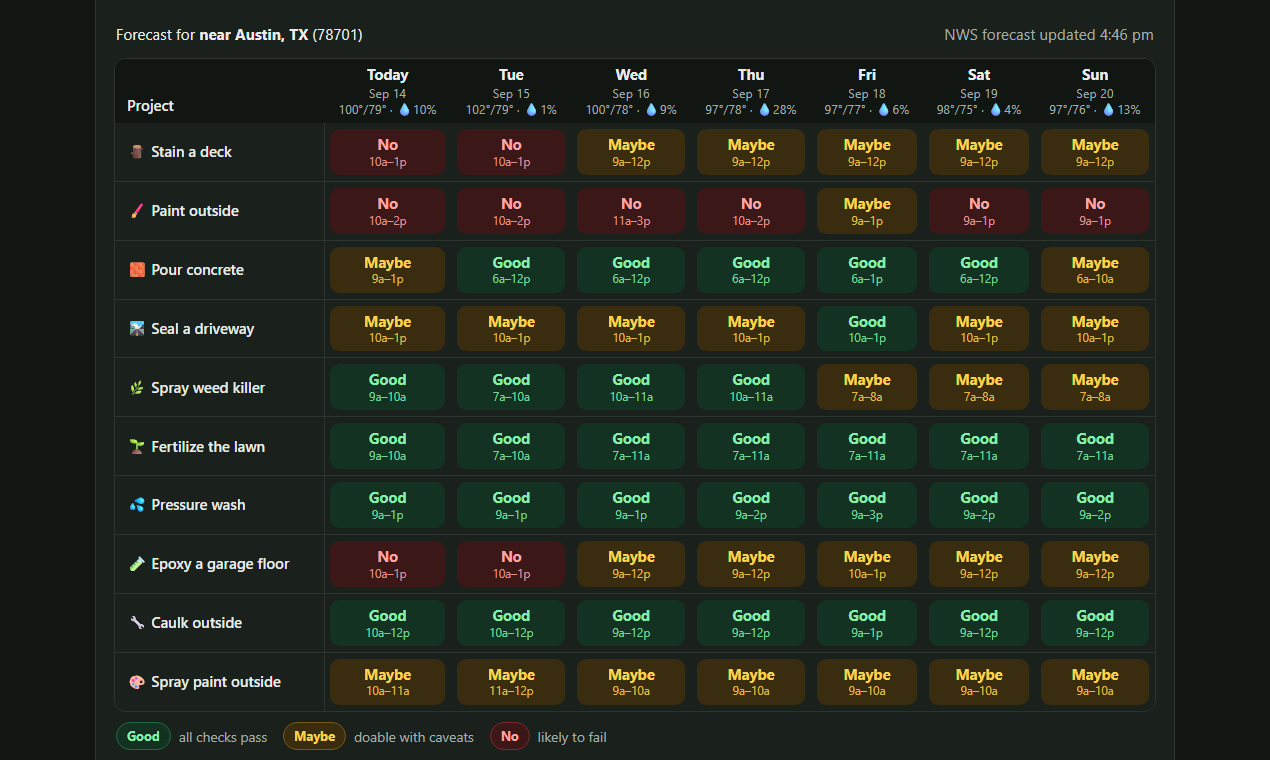
9. Operationalizing Your Season: How ADiyDay Powers Precision Execution
Understanding seasonal thermodynamics gives you the strategic foundation. But executing a flawless project requires real-time, hyper-local tactical data. That is where A DIY Day (adiyday.com) transforms your weekend workflow.
The 7-Day Gridded NOAA Engine
Conventional weather websites give you a 10-day overview showing daily high temperatures and rain icons. They cannot tell you if the dew point spread will drop to 3°F at 6:00 PM, or if overnight temperatures will plummet to 41°F fourteen hours after you finish staining your deck.
ADiyDay connects directly to NOAA’s National Weather Service 2.5-kilometer gridded forecasting grid. When you enter your 5-digit U.S. ZIP code, our system evaluates:
- Active Application Hours: Verifies that temperature, wind, humidity, and solar exposure remain strictly within safe manufacturer TDS thresholds for the 3 to 4 hours you are working.
- Dew Burn-Off Cushion: Automatically blocks early morning hours until solar energy has completely burned off nighttime condensation.
- Post-Application Cure Envelope: Scans hourly forecast metrics for 12, 24, and 48 hours into the future, ensuring your newly applied stain, paint, concrete, or sealer is never destroyed by late-night freezes or unpredicted rainfall.
- Clear Go / Maybe / No-Go Verdicts: Delivers instant color-coded clarity so you never waste hundreds of dollars on materials during an unsafe weather window.
🛠️ The 3-Step Project Execution Protocol
- Step 1 (Wednesday): Check adiyday.com for your ZIP code. Determine whether Saturday or Sunday offers the superior curing envelope.
- Step 2 (Friday): Perform physical site prep—pressure washing, scraping, or masking—ensuring adequate dry time before material application.
- Step 3 (Saturday Morning): Do a 60-second re-check on ADiyDay to verify frontal systems haven’t shifted. Measure surface temperature with an infrared thermometer and execute with confidence!
10. Frequently Asked Questions (FAQ)
Here are answers to the most common questions American homeowners ask when timing their seasonal outdoor projects:
What is the single best month to paint a house exterior in the United States?
Across the majority of the continental United States (Hardiness Zones 5 through 7), September is mathematically the ideal month for exterior house painting. September delivers the lowest average precipitation frequency, moderate ambient temperatures (65°F to 78°F), lower relative humidity than summer, and reduced ultraviolet solar radiation. This allows 100% acrylic latex paint to coalesce gradually without flash-drying or suffering morning/evening thermal shock.
How does soil temperature dictate when to apply crabgrass pre-emergent weed killer?
Crabgrass (Digitaria sanguinalis) and foxtail seeds germinate in early spring as soon as soil temperatures reach 55°F (12.8°C) at a 2-inch depth for four to five consecutive days. Applying pre-emergent herbicide when soil is below 50°F risks chemical degradation and leaching from early spring rains before weed seeds activate; applying after soil exceeds 60°F means seedlings have already sprouted, rendering pre-emergent barriers ineffective.
Why is late spring or autumn better for staining a deck than early spring?
Early spring presents the "Spring Lumber Moisture Trap." Even if air temperatures reach a comfortable 68°F on a sunny April afternoon, wood deck boards often retain 22% to 28% internal moisture content from winter snowmelt and spring rains. Applying penetrating oil or waterborne stain over wood with internal moisture above 15% traps water within wood tracheids. Under summer solar heat, this trapped moisture vaporizes into steam, pushing the stain film off and causing severe peeling within weeks.
When is it strictly too cold to seal an asphalt driveway in the fall?
Driveway sealcoating must stop as soon as pavement surface temperatures drop below 65°F (18.3°C) during application or when ambient overnight temperatures fall below 50°F (10°C). Waterborne asphalt emulsions and coal tar pitch require sustained thermal energy to evaporate water carriers and fuse bitumen particles into a monolithic sheet. Sealing in late October or November in cold northern climates results in a non-coalesced, greasy sludge that washes off into municipal storm drains during the first rainfall.
Can you pour concrete in mid-summer heat?
Yes, but you must adhere to American Concrete Institute (ACI 305R) hot-weather protocols. When high ambient temperatures, low relative humidity, and wind cause the evaporation rate of surface bleed water to exceed 0.20 lb/ft²/hr (1.0 kg/m²/hr), severe plastic shrinkage cracking occurs. Homeowners must pour between 6:00 AM and 9:00 AM, erect windbreaks, apply aliphatic alcohol evaporation retarders, and maintain continuous moist curing or curing blankets for seven days.
Why should exterior caulking be completed during mild spring or autumn temperatures?
Building materials expand in high summer heat and contract in freezing winter cold. Applying elastomeric or polyurethane exterior caulk during thermal extremes locks the joint sealant in an unnatural tension state. Caulk applied during 95°F summer heat will tear or pop off substrate edges when frozen siding contracts in January. Mild temperatures (55°F to 75°F) represent the neutral joint movement state, ensuring equal expansion and contraction capability throughout seasonal cycles.
How does A DIY Day (adiyday.com) enhance seasonal project planning?
While seasonal calendars offer general guidance, real weather fluctuates wildly. A DIY Day pulls high-density, hourly 2.5-kilometer gridded forecast models directly from NOAA for your specific 5-digit U.S. ZIP code. It runs these hourly metrics through 10 peer-reviewed physics and chemistry rule engines, calculating exact go/maybe/no-go verdicts, temperature hold cushions, dew point depressions, and multi-day post-application cure horizons.
Conclusion: Build for Decades, Not Just for the Weekend
Your home is a major financial investment, and your weekends are irreplaceable. Every outdoor home improvement project—from staining a cedar deck to pouring a concrete patio or sealing an asphalt driveway—is an exercise in applied chemistry and physical meteorology.
Do not let arbitrary calendar dates or oversimplified weather icons deceive you. Respect the 55°F soil temperature trigger in spring, chase the shade during the dog days of summer, heed the 3:00 PM dew point cutoff in early autumn, and protect your building envelope before winter freeze sets in.
Before buying materials or opening a single can, visit A DIY Day (adiyday.com), enter your 5-digit ZIP code, and make every outdoor project a lifelong success.
