1. The Weekend Warrior’s Blind Spot: Why Projects Fail
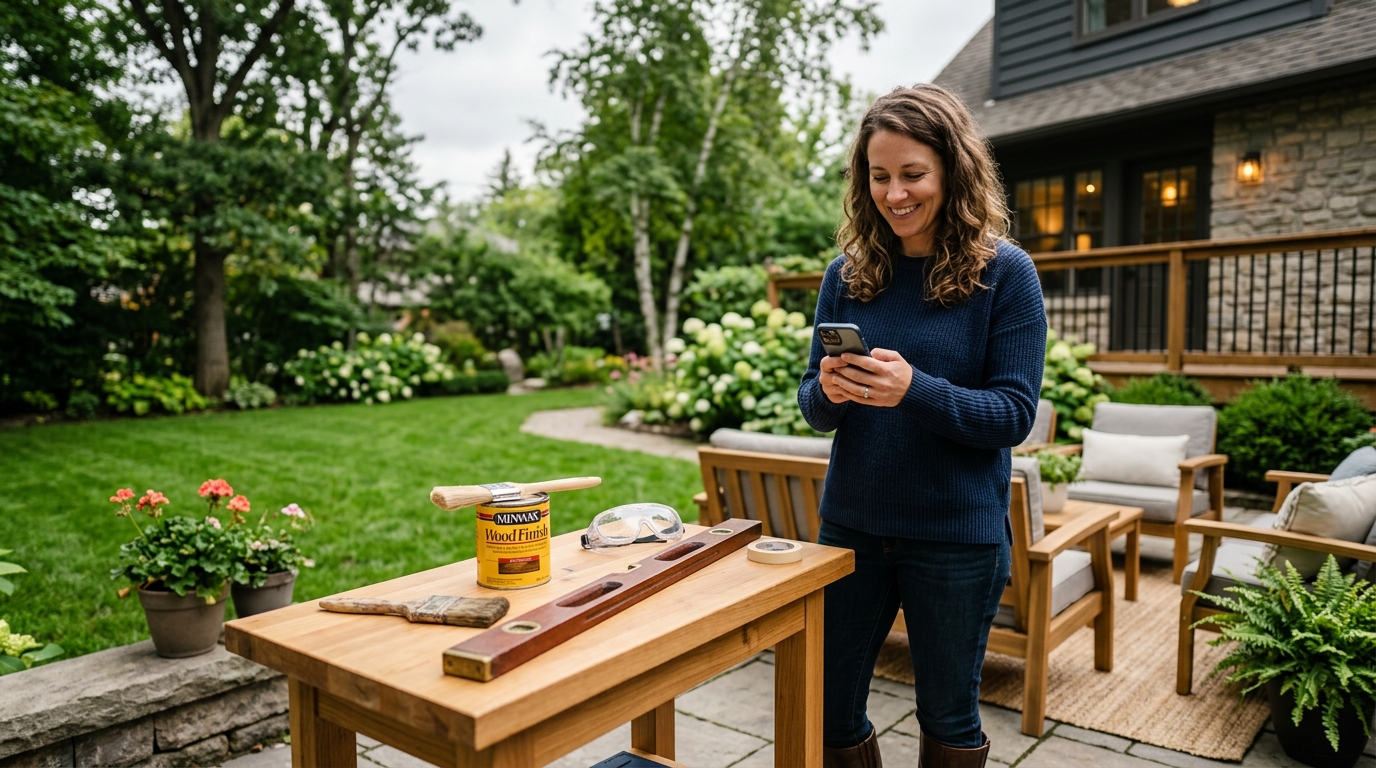
Every Saturday morning between April and October across the United States, an identical ritual unfolds. Millions of homeowners drive to home improvement retailers, fill carts with premium oil-modified wood stains, exterior acrylic paints, hydraulic cement bags, asphalt driveway sealers, two-part epoxy garage kits, and broadleaf weed killers. The ambition is high, the budget is substantial, and the energy is abundant.
Yet by the following Tuesday morning, an alarming percentage of these projects turn into heartbreaking, expensive catastrophes:
- A freshly coated cedar deck develops milky, sticky patches that never cure, peeling under the first summer barbecue.
- A newly poured concrete walkway exhibits spiderweb-like map cracking (craze cracking) and surface dusting across the entire slab.
- An exterior latex repaint on the south-facing facade begins blistering and wrinkling in giant sheets.
- Two coats of asphalt driveway sealer get liquefied by an unpredicted 3:00 AM shower, washing thousands of dollars of black bitumen directly into the neighborhood storm drain.
When these failures occur, homeowners instinctively blame the materials. They assume they purchased a bad batch of paint, bought a cheap deck stain, or mixed their concrete poorly. But forensic coating inspections by organizations like the Master Painters Institute (MPI) and the American Concrete Institute (ACI) reveal an uncomfortable truth: over 75% of exterior residential project failures are caused by atmospheric and weather timing errors, not defective products.
Modern architectural coatings and cementitious binders are miraculous feats of chemical engineering. When applied within their laboratory-defined parameters, they last for decades. When applied outside those windows, their molecular bonds collapse. To protect your home and your wallet, you must understand the invisible atmospheric forces governing every outdoor project—and use specialized tools like A DIY Day (adiyday.com) to identify safe working windows.
2. The 4 Atmospheric Pillars of Exterior Chemical Curing
Most homeowners glance at their phone’s stock weather app, spot a cheerful sun icon and a forecast high of 74°F, and assume conditions are green-lit. Unfortunately, architectural chemistry does not respond to daily average temperatures. Chemical cross-linking, hydraulic hydration, and aerosol droplet ballistics obey four distinct atmospheric variables that generic apps fail to report:
Pillar 1: Ambient Air Temperature vs. True Substrate Temperature
Thermometers measure air temperature in the shade, six feet above ground level. But your exterior paint, wood stain, or concrete slab interacts exclusively with substrate surface temperature. The difference between air temperature and substrate temperature can exceed 35°F:
- Solar Gain: On an 80°F sunny afternoon, dark composite decking, pressure-treated pine, and asphalt pavement readily reach 125°F to 145°F. Applying liquid coatings to sun-scorched boards induces "flash drying," where volatile carriers boil off before resins can penetrate wood tracheids or bond with masonry pores. This leaves a weak surface film prone to immediate flaking.
- Radiational Cooling: Conversely, in the late autumn, concrete slabs and exterior siding lose heat rapidly to clear night skies. Even if the air thermometer reads 52°F, the horizontal ground temperature may drop to 38°F, halting chemical hydration and latex coalescence.
Pillar 2: Dew Point Spread and Microscopic Condensation
The dew point is the atmospheric temperature at which air becomes 100% saturated with water vapor and moisture begins condensing into liquid droplets. The critical metric every DIYer must track is the dew point spread (Ambient Temperature minus Dew Point Temperature).
Whenever the dew point spread narrows to less than 5°F (approx. 3°C), microscopic liquid moisture condenses on all exposed surfaces—even if the sky appears completely clear. This invisible condensation causes:
- Surfactant Leaching in Latex Paint: Water-soluble ingredients are pulled to the paint surface by moisture, forming unsightly sticky brown streaks that permanently mar the sheen.
- Amine Blushing in Garage Epoxy: Moisture reacts chemically with curing amines in two-part epoxies, forming an insoluble greasy carbamate salt film that prevents topcoat adhesion and creates yellow discoloration.
- Stain Clouding & Blistering: Trapped moisture under oil stain creates milky hazing and prevents wood cell saturation.
Pillar 3: Relative Humidity (RH) & Vapor Pressure Deficits
Relative humidity dictates the rate at which water and solvents can physically evaporate into the surrounding atmosphere. For waterborne exterior paints, stains, and driveway sealers, relative humidity must remain between 40% and 85%:
- High Humidity (>85%): The atmosphere is so saturated that water molecules cannot leave the curing coating film. Solvent coalescence stalls, leaving the coating soft, tacky, and highly vulnerable to airborne dirt, insect adhesion, and sudden rain washing.
- Ultra-Low Humidity (<30%): In arid climates (such as the American Southwest), bone-dry air sips water out of fresh concrete slabs faster than bleed water can rise to the surface. This triggers catastrophic plastic shrinkage cracking across the concrete matrix.
Pillar 4: The Multi-Day Post-Application Cure Window
The most dangerous trap in outdoor DIY is confusing dry-to-the-touch with chemical cure. A can of deck stain or exterior paint may claim "dry to touch in 2 hours." However, complete chemical polymer cross-linking and moisture resistance take 24 to 72 continuous hours.
If a heavy downpour arrives 18 hours after you finish staining a deck, or if overnight temperatures plummet to 34°F 14 hours after you pour a concrete walkway, your project will suffer severe structural or aesthetic impairment. A valid project forecast must evaluate the hours after you pack up your brushes.
3. The 10 Core Outdoor DIY Projects & Their Exact Meteorological Windows
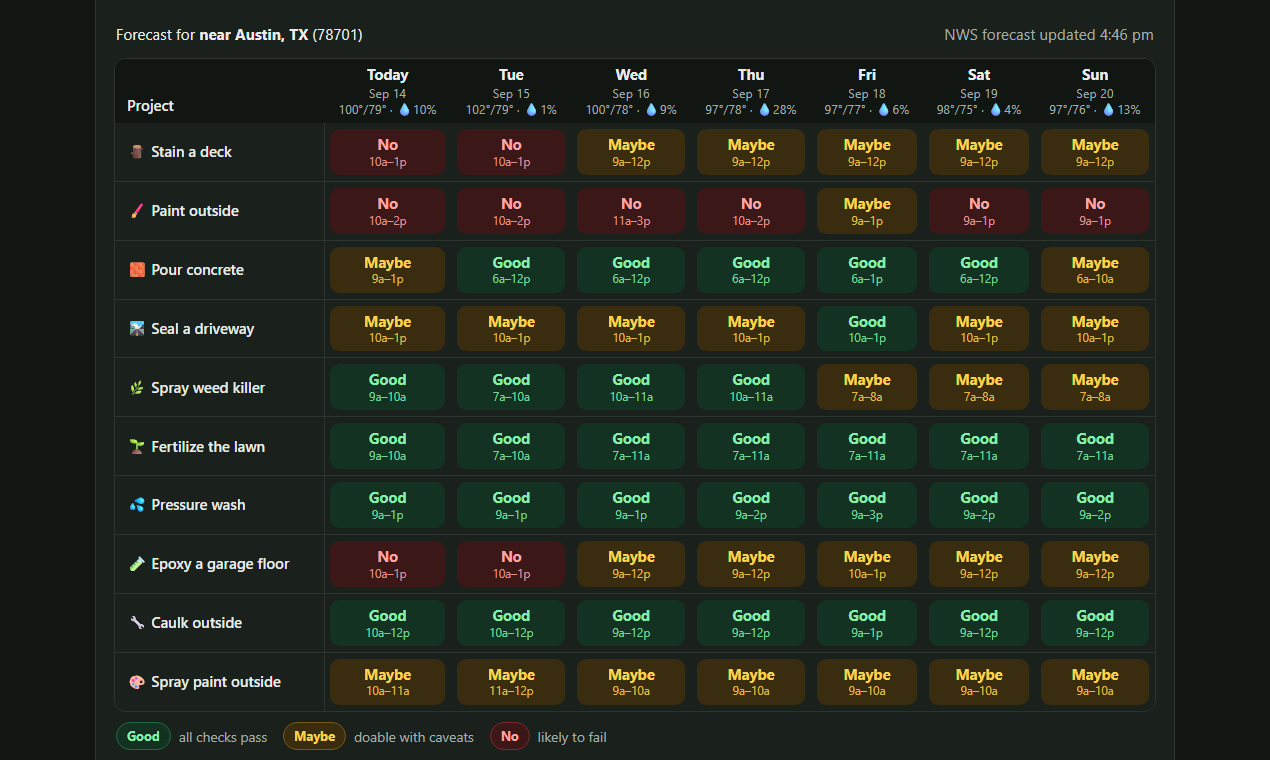
Let us examine the exact atmospheric rulesets, manufacturer specifications (TDS), and field failure mechanisms for the ten most popular outdoor home improvement projects supported by the adiyday.com weather engine:
1. Staining a Wood Deck (Cedar, Redwood, Pressure-Treated Pine, Ipe)
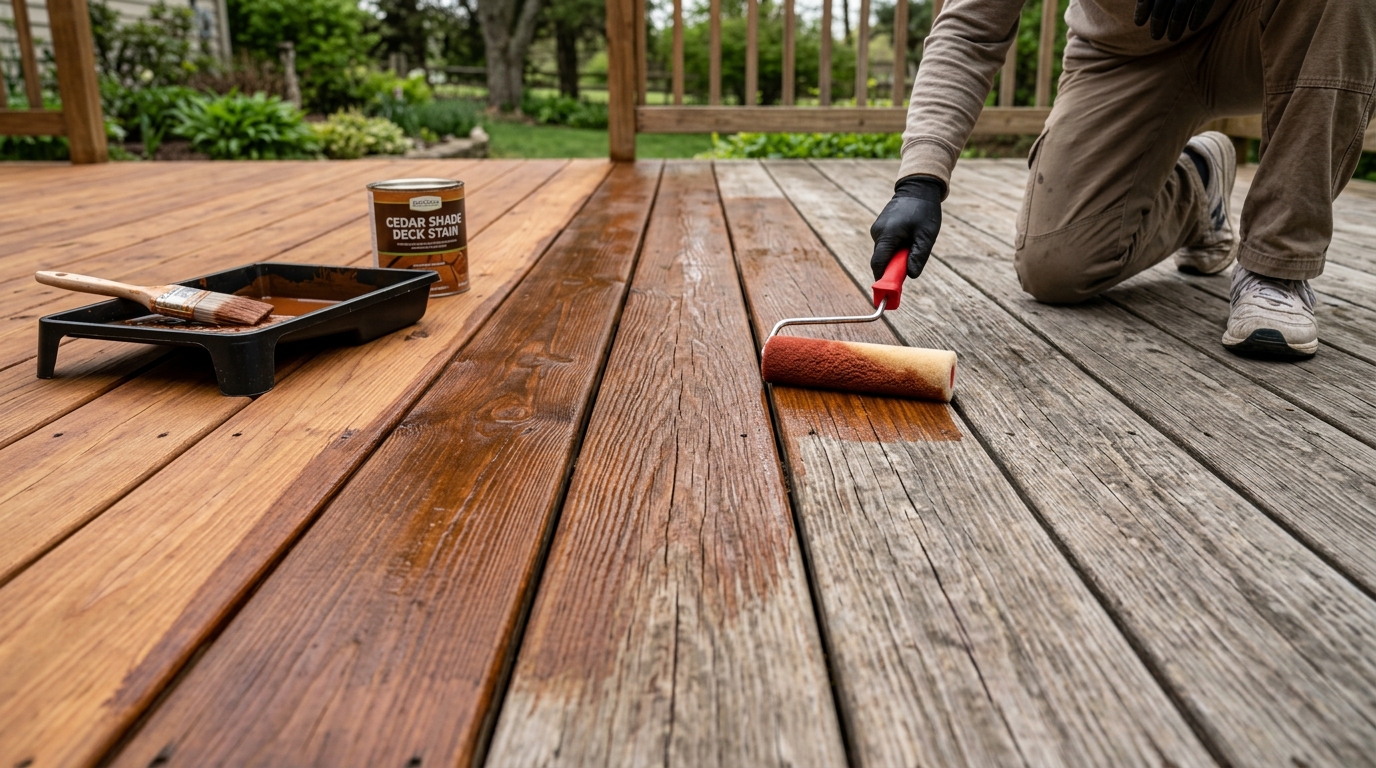
Restoring an outdoor wood deck requires three distinct environmental conditions: bone-dry lumber, moderate ambient temperatures, and an extended dry curing window.
- Substrate Moisture Content: Wood internal moisture must register below 15% (verified with a pin-type moisture meter). If you stain boards saturated from recent rain or power washing, internal moisture heats up under the sun, turning to vapor and blowing the stain right off the wood surface.
- Temperature Sweet Spot: Ambient air and wood surface temperatures must remain between 50°F and 90°F (10°C to 32°C) during application and for at least 12 hours afterward. Below 50°F, penetrating oils become thick and gummy; above 90°F, stain flashes before soaking in, leaving blotchy lap marks.
- Rain-Free Horizon: You need 24 to 48 rain-free hours post-application. If water beads on fresh stain before 24 hours, it will leave permanent water spots and white blemishes.
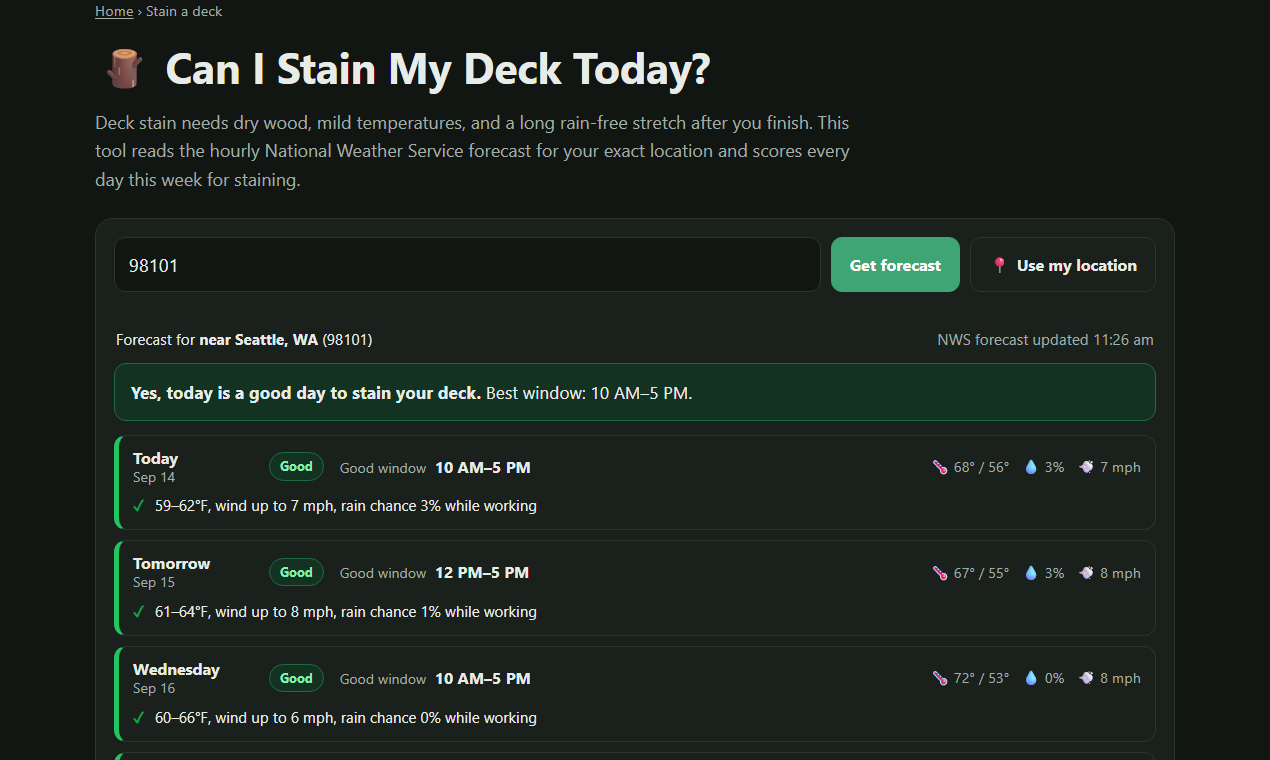
- Direct Tool Forecast: Check your localized 7-day deck staining window at Can I Stain My Deck Today?.
2. Exterior House Painting (Siding, Trim, Stucco & Masonry)
Applying 100% acrylic latex or alkyd paint to exterior home surfaces demands strict thermal stability for proper film coalescence.
- Thermal Windows: Standard acrylic paints require temperatures above 50°F (10°C) that persist through the overnight cooling cycle. Specialty cold-weather formulas allow work down to 35°F (1.7°C), but curing speed slows drastically.
- Sun Chasing: Never paint siding in direct midday sunlight. Professional painters "chase the shade," painting east-facing walls in the afternoon and west-facing walls in the morning to prevent blistered bubbles caused by evaporating solvents trapped under a rapidly skinned surface.
- Dew Point Cushion: Maintain a minimum 5°F dew point spread. Stop painting at least 3 to 4 hours before sunset so the latex film can coalesce before heavy evening dew forms.
- Direct Tool Forecast: Review your paint-ready weather window at Can I Paint Outside Today?.
3. Pouring Concrete Patios, Footings, and Walkways
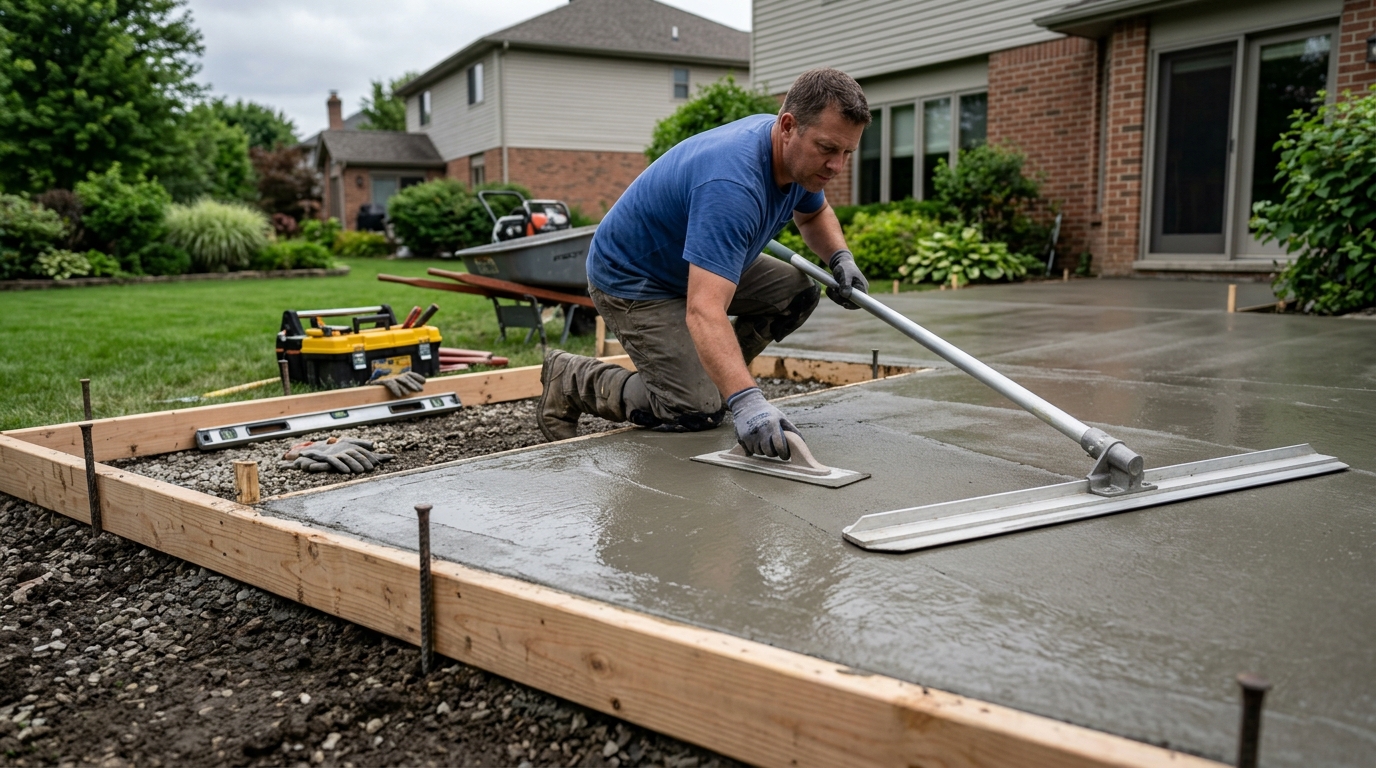
Concrete does not "dry"; it hydrates through an exothermic chemical crystallization between Portland cement, aggregate, and water. Managing hydration speed is everything.
- Freezing Hazards (ACI 306R): Fresh concrete must never freeze within 48 to 72 hours of pouring. Freezing water inside the wet mix expands by 9%, destroying the micro-crystalline bond and robbing the finished slab of up to 50% of its designed compressive strength.
- The Uno Evaporation Equation (ACI 305R): In hot, dry, or windy weather, surface water evaporates faster than internal bleed water can rise. When the evaporation rate exceeds 0.2 lb/ft²/hr (1.0 kg/m²/hr), severe plastic shrinkage cracking tears across the surface. The ADiyDay methodology engine actively computes the Uno equation hourly to flag this danger.
- Rain Impact: Hard rain hitting unhardened concrete washes away fine cement paste, exposing loose sand and creating a dusty, weakened surface that permanently spalls.
- Direct Tool Forecast: Plan your pour window safely at Can I Pour Concrete Today?.
4. Asphalt Driveway Sealing (Emulsion & Coal Tar Pitch)
Driveway sealers are water-based asphalt emulsions that require ambient heat and dry breezes to evaporate their water carrier and fuse microscopic asphalt particles into a solid waterproof barrier.
- Pavement Temperature Floor: Both air and pavement temperatures must remain above 65°F (18°C) during application and remain above 50°F overnight. Sealing a cold driveway in late October or November leads to tacky, unbonded sludge that tracks into your house.
- Rainwash Vulnerability: A minimum of 24 to 48 dry hours post-application is mandatory. If rain strikes an uncured emulsion within 8 hours, the water-soluble surfactants dissolve, washing black asphalt pitch across lawns and into municipal waterways.
- Direct Tool Forecast: Check your local asphalt sealing conditions at Can I Seal My Driveway Today?.
5. Spraying Lawn Weed Killers & Selective Herbicides
Applying herbicides like 2,4-D, dicamba, triclopyr, or non-selective glyphosate requires navigating physical droplet physics and plant biological uptake.
- The 3–10 mph Wind "Goldilocks Zone": Sustained winds over 10 mph cause physical droplet drift, killing prized flowerbeds, vegetable gardens, and neighbor landscaping. Crucially, winds under 3 mph are equally hazardous: complete stillness usually signals a temperature inversion, where microscopic chemical mists hang in stagnant air and drift unpredictably for miles.
- Thermal Vaporization: When temperatures exceed 85°F (29°C), ester-based herbicides rapidly vaporize into volatile gases that burn non-target turf and surrounding ornamental trees.
- Rainfast Window: Herbicides need between 1 and 6 hours of rain-free foliage absorption to penetrate leaf cuticles before rain washes the active ingredient into the soil.
- Direct Tool Forecast: Verify herbicide safety windows at Can I Spray Weed Killer Today?.
6. Fertilizing the Lawn (Granular & Liquid Turf Nutrition)
Lawn fertilizer application represents a delicate balance between nutrient absorption and environmental stewardship.
- The Rain Sweet Spot: Granular fertilizers must be watered into the root zone to activate nitrogen and potassium and prevent leaf blade chemical scorching. The ideal forecast features 0.10 to 0.50 inches of gentle rain within 24 to 48 hours of application.
- Downpour Runoff Hazard: Applying fertilizer immediately ahead of a torrential storm (>1.0 inch of precipitation) causes surface runoff, flushing expensive nitrogen into municipal storm basins and violating watershed protection laws.
- Direct Tool Forecast: Plan your turf feeding schedule at Can I Fertilize My Lawn Today?.
7. Exterior Pressure Washing (Siding, Decks, Concrete & Pavers)
While rain itself does not disrupt pressure washing, the meteorological aftermath dictates whether your cleaning effort was worthwhile.
- Freeze Fracturing: High-pressure water forces deep moisture into porous brick, stone, and concrete micro-fissures. If temperatures drop below 32°F (0°C) within 24 hours, that trapped water freezes and expands, causing spalling and surface fracturing.
- Prerequisite Drying Window: Pressure washing is almost always Step 1 before staining or painting. If you do not have 48 to 72 hours of warm, dry weather immediately following the wash, the substrate will remain too damp for Step 2.
- Direct Tool Forecast: Check power washing conditions at Can I Pressure Wash Today?.
8. Garage Floor Epoxy Coating (100% Solids & Cycloaliphatic Polyaspartics)
Two-part epoxy and polycuramine floor systems are the most chemically sensitive DIY coatings on the market, demanding tight environmental control.
- Concrete Moisture Vapor Emission (MVE): Concrete slabs resting on grade constantly transpire sub-slab moisture. Slabs must be tested with a taped plastic sheet or calcium chloride test. High atmospheric humidity combined with damp sub-grade moisture causes blistering and delamination.
- Relative Humidity <80% & Dew Point Spread: High humidity causes curing amines to react with atmospheric carbon dioxide and moisture, producing "amine blushing"—a sticky, cloudy residue that ruins the high-gloss showroom finish.
- Concrete Slab vs. Air Temperature: Unheated garage slabs are often 10°F to 15°F colder than the outside air in spring. Epoxy requires a minimum slab temperature of 55°F to 60°F to kick off the exothermic curing reaction.
- Direct Tool Forecast: Evaluate garage floor epoxy suitability at Can I Epoxy My Garage Floor Today?.
9. Exterior Caulking & Joint Sealing (Polyurethane & Silicone)
Sealing exterior window casings, door perimeters, expansion joints, and siding junctions protects your building envelope from moisture intrusion and drafts.
- Substrate Thermal Movement: Materials expand in summer heat and contract in winter cold. Applying caulk during extreme thermal highs or lows causes joints to tear or pop when seasonal temperatures reverse. Mild temperatures (55°F to 75°F) represent the ideal neutral joint state.
- Moisture Skinning: While moisture-cure polyurethanes require slight ambient humidity to cure, liquid rain before skin-over (typically 4 to 8 hours) washes away the tooling profile and creates pinhole leaks.
- Direct Tool Forecast: View optimal sealing windows at Can I Caulk Outside Today?.
10. Exterior Spray Painting (Patio Furniture, Metal Gates & Hardware)
Aerosol and HVLP spray painting delivers factory-smooth finishes only when atmospheric conditions permit fine atomization.
- Wind Velocity Limits: Spraying requires winds strictly under 8 mph. Higher winds blow 50% or more of your expensive aerosol coating into the atmosphere, creating hazardous overspray onto parked cars, stone pavers, and nearby structures.
- Aerosol Blushing: Rapidly expanding aerosol propellants cool the paint droplet mid-flight. In relative humidity exceeding 75%, this cooling causes condensation to form inside the wet paint film, producing a milky, dull finish known as blushing.
- Direct Tool Forecast: Check outdoor spray painting conditions at Can I Spray Paint Outside Today?.
4. Regional Climate Nuances: Navigating US Microclimates
A major reason generic DIY advice fails is that the continental United States contains vastly diverse climate zones. What works in coastal Florida will ruin a project in the high deserts of Arizona or the humid forests of Michigan. Here is how seasonal weather windows vary across the nation:
| U.S. Region | Primary Meteorological Threat | Prime Working Windows | Key Precautions |
|---|---|---|---|
| Pacific Northwest (WA, OR) | Subsurface moisture, prolonged light drizzle, high ambient humidity. | July through early September | Always test wood with a moisture meter (<15%); avoid early spring staining even on sunny days due to deep dampness. |
| Southeast & Gulf Coast (FL, GA, TX, AL, NC) | Sudden 3:00 PM convective storms, extreme humidity (>85%), substrate heat >135°F. | October through November; March through April | Stop work by 1:00 PM before afternoon pop-up thunderstorms form; avoid dark coatings in direct July sun. |
| Midwest & Great Lakes (IL, OH, MI, WI, MN) | Rapid frontal swings, overnight frost, spring freeze-thaw cycles. | Late May through June; September to early October | Monitor overnight low drops closely; avoid April concrete pours subject to late hard freezes. |
| Desert Southwest (AZ, NV, NM, UT) | Ultra-low humidity (<20%), flash drying, extreme thermal shock, high UV. | March through April; October through November | Use concrete evaporation retarders or curing blankets; stain decks only in early morning shade before 10:00 AM. |
| Northeast (NY, PA, MA, NJ, CT) | Lingering spring dampness, heavy coastal fog, early autumn chill. | June and September | Wait for morning dew burn-off (after 9:30 AM); wrap up by 4:00 PM before rapid evening temperature plunges. |
For detailed, pre-calculated 7-day multi-project forecasts across hundreds of American metropolitan areas, visit the ADiyDay All Cities Directory.
5. The Financial Math: Cost of Weather Failure vs. Timing Success
Homeowners often justify rushing an outdoor project by thinking, "I already bought the materials, and I only have this weekend free." But rushing into a bad weather window is a mathematical trap. When an exterior coating or concrete slab fails due to weather, remediation costs far more than the original project:
| Project | Initial DIY Cost | Failure Mechanism | Professional Remediation Cost |
|---|---|---|---|
| Deck Staining (500 sq ft) | $220 (Stain + applicators) | Trapped moisture peels stain; blotchy flash-dry lap marks. | $1,600 – $2,400 (Chemical stripping, deep pressure wash, heavy orbital sanding, re-staining). |
| Concrete Patio (12x16 ft) | $750 (Ready-mix, forms, rebar) | Freezing within 48 hrs ruins strength; plastic shrinkage crazing. | $3,800 – $5,500 (Jackhammer demolition, concrete disposal, re-excavation, re-pouring). |
| Garage Epoxy (2-Car Garage) | $280 (Two-part kit + acid etch) | Amine blush from humidity; hot-tire pickup from cold slab. | $1,800 – $2,800 (Diamond floor grinding to remove failed epoxy, vacuum prep, commercial recoat). |
| Driveway Sealing (Driveway) | $110 (2 pails sealer + squeegee) | Rain wash-off within 8 hours liquefies pitch. | $900 – $1,800 (Environmental gutter pressure washing, asphalt power scrubbing, re-coating). |
Waiting three to five days for an optimal weather window on adiyday.com costs exactly zero dollars. Rushing ahead into a marginal window can cost you thousands.
6. The Homeowner’s Essential Weather Diagnostic Toolkit
To eliminate guesswork and bridge the gap between regional weather models and your hyper-local microclimate, keep these four inexpensive diagnostic instruments in your tool chest:
- Pin-Type Digital Wood Moisture Meter: Never guess whether deck boards or siding are dry enough. Push the two metal pins into several floorboards in both sunny and shaded areas. If the digital readout shows above 15% moisture content, wait another 24 to 48 hours of dry weather.
- Infrared Non-Contact Thermometer: Point the laser gun directly at your wood siding, asphalt driveway, or concrete slab. You will frequently find that while your thermometer reads 78°F, the south-facing boards read 118°F. If the surface is over 90°F–95°F, postpone coating application.
- Handheld Digital Anemometer: Essential for weed spraying and aerosol paint. Test wind speed at head height where you plan to spray. If gusts exceed 10 mph—or if air is dead-calm (under 2 mph) under inversion skies—keep the spray nozzle capped.
- The Simple Water-Drop Test (Free): Sprinkle a few tablespoons of clean water across your concrete or wood deck. If the water beads up into droplets, an old coating is still sealing the pores, or the wood is saturated. If the water absorbs within 60 seconds, the porosity is open and ready to accept finish.
7. Inside the ADiyDay Engine: Algorithmic Precision Powered by NOAA
Why is A DIY Day (adiyday.com) fundamentally different from conventional commercial weather sites? It comes down to data resolution and project-specific chemical logic.
High-Density NOAA 2.5km Gridded Forecasts
When you enter your 5-digit U.S. ZIP code on ADiyDay, our system uses U.S. Census ZCTA gazetteer tables to pinpoint your exact geographic latitude and longitude. It then connects to the National Oceanic and Atmospheric Administration’s high-resolution National Weather Service API (api.weather.gov), retrieving an hourly 2.5-kilometer gridded atmospheric model specifically for your neighborhood.
10 Independent Physics & Chemistry Rule Engines
Rather than simply showing you a forecast, ADiyDay passes that hourly data stream through ten specialized algorithmic engines developed from manufacturer technical data sheets and engineering standards:
- Application Window Verification: Confirms conditions satisfy minimum and maximum thresholds for the 3 to 4 hours of active work.
- Dew Burn-Off & Setting Limits: Restricts work to safe daytime hours (e.g., between 9:00 AM and 5:00 PM) to avoid morning dew and evening condensation.
- Overnight Temperature Holds: Analyzes hourly temperatures for 12, 24, and 48 hours post-application to prevent cold-shock failures.
- Dew Point Depression Analysis: Enforces the critical 5°F spread to protect coatings from moisture blush and surfactant leaching.
- Precipitation Before & After: Evaluates rain probabilities both 24 hours before (substrate dryness) and 24 to 72 hours after (curing integrity).
Client-Side Privacy & Speed
Unlike ad-heavy bloated platforms, ADiyDay performs its algorithmic evaluation directly inside your modern web browser. No personal location data is stored on remote servers, and forecast results render in milliseconds. Learn more about our technical architecture in our Documentation & Methodology Guide or read our story on the About Us Page.
8. The 5-Day Weekend Planning Protocol
To ensure flawless execution on your next outdoor home improvement project, adopt this verified 5-day professional workflow:
- Wednesday Evening (Strategic Planning): Enter your ZIP code on adiyday.com to review the upcoming 7-day matrix. Determine whether Saturday or Sunday offers the superior curing window for your specific project.
- Thursday Afternoon (Material Procurement): Purchase your coatings, supplies, personal protective equipment (PPE), and applicators with confidence, knowing a verified weather window is approaching.
- Friday (Surface Preparation): Complete cleaning, pressure washing, chemical stripping, or masking. Remember: thorough preparation takes twice as long as coating application.
- Saturday Morning (Real-Time Re-Check): Perform a final 60-second check on adiyday.com to confirm local weather fronts haven’t shifted. Measure surface temperature with an infrared gun and wood moisture with a meter.
- Execution (Chase the Shade): Work during peak hours of indirect light. Wrap up all wet applications by 3:00–4:00 PM to give coatings a minimum 4-hour thermal cushion before sunset.
9. Frequently Asked Questions (FAQ)
Here are answers to the most common questions American homeowners ask when timing their exterior projects:
What is the absolute lowest temperature you can safely stain a deck?
For most oil- and water-based penetrating deck stains, 50°F (10°C) is the absolute minimum threshold for both ambient air and wood substrate temperature. Crucially, the temperature must stay above 50°F throughout the initial 12 to 24-hour drying period. While select low-temperature formulas allow application down to 40°F, standard stains become excessively viscous, fail to penetrate wood pores, and remain tacky when applied below 50°F.
How long does exterior paint need to dry before rain?
Standard exterior 100% acrylic latex paint requires a minimum of 4 to 8 hours of dry weather under mild temperatures (60°F–75°F) and low humidity to form a rain-resistant outer film. However, full polymer coalescence and moisture cure require a 24 to 48-hour rain-free window. If rain strikes within the first 4 hours, surfactant leaching, streaking, and water-spotting will occur.
Can I pour concrete if it will freeze overnight?
Never pour concrete if ambient or ground temperatures will drop below 32°F (0°C) within 48 to 72 hours without heated curing blankets or chemical accelerators. If fresh concrete freezes before reaching a compressive strength of at least 500 psi, the expanding ice crystals rupture the developing silicate matrix, permanently reducing structural strength by up to 50% and causing severe surface scaling.
What happens if you seal a driveway right before it rains?
Asphalt emulsion and coal tar driveway sealers are waterborne colloidal suspensions. If rain falls within 8 to 12 hours of application before the emulsion coalesces, the water-soluble binder dissolves. The unbonded black pitch washes off into yard landscaping, storm drains, and sidewalks, ruining the coating and creating an environmental runoff hazard.
Why should you never spray weed killer on a completely calm day?
Completely calm conditions (wind speeds under 3 mph) often indicate a surface temperature inversion, where a layer of cold air is trapped beneath warm air. In an inversion, aerosolized herbicide droplets remain suspended like fog and can drift unpredictably hundreds of yards into neighbor properties or vegetable gardens. The safe "Goldilocks zone" for herbicide spraying is a steady 3 to 10 mph breeze blowing away from sensitive plants.
How does A DIY Day (adiyday.com) calculate project weather verdicts?
ADiyDay pulls high-resolution hourly forecast data directly from the U.S. National Weather Service (NOAA) 2.5-kilometer grid for any 5-digit U.S. ZIP code. It runs that gridded meteorological data through 10 distinct, peer-reviewed physical and chemical rule engines that evaluate temperature holds, dew point spreads, humidity ceilings, wind thresholds, and multi-day post-application cure windows.
Conclusion: Never Waste Another Weekend on Weather Guesswork
Your home is your most valuable financial asset, and your free weekends are your most precious personal resource. Do not risk hundreds of dollars in materials and dozens of hours of grueling physical labor on a flip of the coin or an oversimplified phone weather app.
Whether you are planning to stain your deck, paint your exterior siding, pour a new concrete patio, or seal your asphalt driveway, let meteorological science be your ultimate unfair advantage.
Before unscrewing a single paint lid or opening your first bag of concrete, visit A DIY Day (adiyday.com), enter your 5-digit ZIP code, and build with total confidence.
