
Arkansas weather and outdoor projects
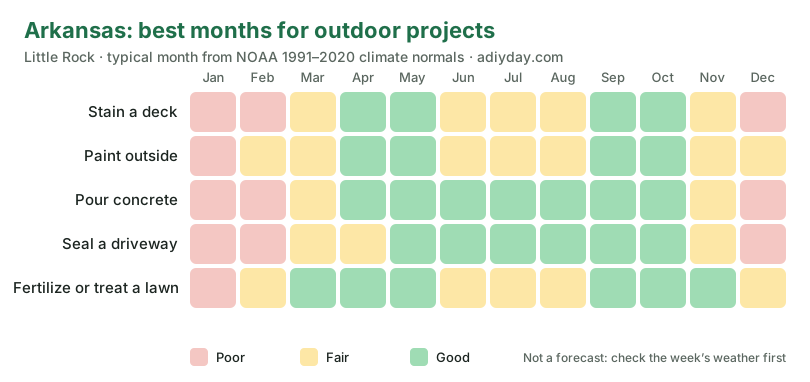
Arkansas has hot, humid summers, mild to cool winters and frequent spring storms. Spring is the wettest season, with heavy rain events common from March through May, so finding several dry days in a row for deck staining can be hard. Late summer and fall are often drier and give the most dependable stretches for staining and painting.
The Ozarks in the northwest are cooler and see more frost and occasional ice, while the southern lowlands are warmer and more humid. Ice storms are a winter risk statewide. Fresh concrete in winter needs protection on nights in the 20s, which happen most years in the north of the state.
Frost dates in Arkansas
In Little Rock, the median last spring freeze (32°F) is around March 16 and the median first fall freeze is around November 16, a frost-free season of about 245 days.
In Fort Smith, the median last spring freeze (32°F) is around March 25 and the median first fall freeze is around November 6, a frost-free season of about 224 days.
Frost dates matter for concrete, which must not freeze in its first 48 hours, for paint and caulk that need nights above their minimum, and for lawn care, since crabgrass preventer goes down as the soil warms in spring. See how late in fall you can stain, paint or seal.
Best time to stain a deck in Arkansas
In Little Rock, the most reliable months are April–May and September–October. March, June–August and November can also work on the right days. December–February is too cold, with average highs around 51°F. In March, nights average about 44°F, so finish early on mild days and check the overnight low. June–August is hot, with highs near 90°F, so start early and keep out of full afternoon sun. November is cool, with highs around 60°F, so choose the warmest afternoons.
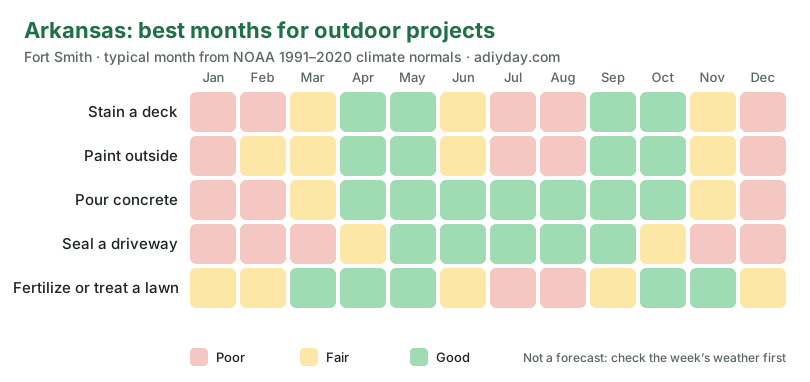
In Fort Smith, the most reliable months are April–May and September–October. March, June and November can also work on the right days. December–January is too cold, with average highs around 52°F. In February, nights average about 33°F, too cold for the coating to dry and cure overnight. July–August is hot, with average highs near 94°F and about 23 days a month at 90°F or more, so work early in the day. In March and November, nights average about 41°F, so finish early on mild days and check the overnight low. June is hot, with highs near 89°F, so start early and keep out of full afternoon sun.
Check this week’s hour-by-hour verdict with the deck staining forecast.
Best time to paint outside in Arkansas
In Little Rock, the most reliable months are April–May and September–October. February–March, June–August and November–December can also work on the right days. January is too cold, with average highs around 49°F. February and December are cool, with highs around 52°F, so choose the warmest afternoons. In March and November, nights average about 43°F, so finish early on mild days and check the overnight low. June–August is hot, with highs near 90°F, so start early and keep out of full afternoon sun.
In Fort Smith, the most reliable months are April–May and September–October. February–March, June and November can also work on the right days. In December–January, nights average about 31°F, too cold for the coating to dry and cure overnight. July–August is hot, with average highs near 94°F and about 23 days a month at 90°F or more, so work early in the day. February is cool, with highs around 57°F, so choose the warmest afternoons. In March and November, nights average about 41°F, so finish early on mild days and check the overnight low. June is hot, with highs near 89°F, so start early and keep out of full afternoon sun.
Check this week’s hour-by-hour verdict with the exterior painting forecast.
Best time to pour concrete in Arkansas
In Little Rock, the most reliable months are April–October. March and November can also work on the right days. December–February averages about 11 nights a month at or below 32°F, so fresh concrete needs blankets or heated enclosures. March and November bring about 3 freezing nights a month, so pick a mild spell and keep curing blankets on hand.
In Fort Smith, the most reliable months are April–October. March and November can also work on the right days. December–February averages about 17 nights a month at or below 32°F, so fresh concrete needs blankets or heated enclosures. March and November bring about 6 freezing nights a month, so pick a mild spell and keep curing blankets on hand.
Check this week’s hour-by-hour verdict with the concrete pouring forecast.
Best time to seal a driveway in Arkansas
In Little Rock, the most reliable months are May–October. March–April and November can also work on the right days. December–February is too cold, with average highs around 51°F. March and November are cool, with highs around 61°F, so choose the warmest afternoons. In April, nights average about 52°F, so finish early on mild days and check the overnight low.
In Fort Smith, the most reliable months are May–September. April and October can also work on the right days. December–February is too cold, with average highs around 54°F. In March and November, nights average about 41°F, too cold for the coating to dry and cure overnight. In April and October, nights average about 50°F, so finish early on mild days and check the overnight low.
Check this week’s hour-by-hour verdict with the driveway sealing forecast.
Best time to fertilize or treat a lawn in Arkansas
In Little Rock, the most reliable months are March–May and September–November. February, June–August and December can also work on the right days. January is too cold, with average highs around 49°F. February and December are cool, with highs around 52°F, so choose the warmest afternoons. June–August is hot, with highs near 90°F, so start early and keep out of full afternoon sun.
In Fort Smith, the most reliable months are March–May and October–November. June, September and December–February can also work on the right days. July–August is hot, with average highs near 94°F and about 23 days a month at 90°F or more, so work early in the day. December–February is cool, with highs around 54°F, so choose the warmest afternoons. June and September are hot, with highs near 88°F, so start early and keep out of full afternoon sun.
Check this week’s hour-by-hour verdict with the lawn fertilizer forecast.
How the weather differs across Arkansas
| Place | Hottest month avg high | Coldest month avg low | Rain per year | Last spring freeze | First fall freeze |
|---|---|---|---|---|---|
| Little Rock | 91°F | 32°F | 52 in | March 16 | November 16 |
| Fort Smith | 94°F | 30°F | 47 in | March 25 | November 6 |
Monthly weather in Little Rock
| Month | Avg high | Avg low | Wet days* | Rain | Freezing nights |
|---|---|---|---|---|---|
| January | 49°F | 32°F | 6 | 3.5 in | 14 |
| February | 54°F | 36°F | 6 | 3.9 in | 9 |
| March | 63°F | 44°F | 8 | 5.1 in | 3 |
| April | 72°F | 52°F | 7 | 5.5 in | 0 |
| May | 79°F | 61°F | 8 | 5.4 in | 0 |
| June | 87°F | 69°F | 6 | 3.4 in | 0 |
| July | 91°F | 72°F | 6 | 3.9 in | 0 |
| August | 91°F | 71°F | 5 | 3.6 in | 0 |
| September | 84°F | 64°F | 4 | 3.0 in | 0 |
| October | 73°F | 53°F | 6 | 4.6 in | 0 |
| November | 60°F | 42°F | 6 | 4.7 in | 3 |
| December | 51°F | 35°F | 7 | 5.1 in | 11 |
*Days with at least 0.1 inch of rain or melted snow. Freezing nights: average nights a month at or below 32°F. Humidity is calculated from NOAA hourly normal temperature and dew point at 3 PM.
Monthly weather in Fort Smith
| Month | Avg high | Avg low | Wet days* | Rain | 3 PM humidity | Freezing nights |
|---|---|---|---|---|---|---|
| January | 51°F | 30°F | 5 | 2.9 in | 49% | 20 |
| February | 57°F | 33°F | 5 | 2.7 in | 45% | 13 |
| March | 66°F | 42°F | 6 | 3.9 in | 42% | 5 |
| April | 75°F | 50°F | 7 | 4.9 in | 44% | 1 |
| May | 81°F | 60°F | 7 | 5.6 in | 52% | 0 |
| June | 89°F | 68°F | 6 | 4.6 in | 51% | 0 |
| July | 94°F | 72°F | 5 | 3.4 in | 47% | 0 |
| August | 94°F | 71°F | 5 | 3.6 in | 46% | 0 |
| September | 87°F | 63°F | 5 | 4.0 in | 46% | 0 |
| October | 76°F | 51°F | 5 | 4.4 in | 44% | 0 |
| November | 63°F | 40°F | 5 | 3.9 in | 46% | 7 |
| December | 53°F | 32°F | 5 | 3.5 in | 50% | 16 |
Use the averages, then check the forecast
These ratings describe a typical month, not a particular week. A warm spell in a “poor” month can give you a good day, and a wet week can spoil a “good” one. Use this page to plan the season, then check the 7-day forecast for your ZIP code before you buy materials or book help. Each project forecast checks the hours after you finish too: overnight lows, dew and rain that would ruin fresh stain, paint, sealer or concrete.
About this data
Monthly temperatures, rain days, snowfall and freeze dates are NOAA National Centers for Environmental Information (NCEI) U.S. Climate Normals for 1991–2020 at LITTLE ROCK, FT SMITH RGNL AP. Ratings apply the same temperature limits as our forecasts (for example, 50°F or warmer for deck stain and driveway sealer, and no freezing nights for new concrete) to the average month. Your product label always takes priority.
Frequently asked questions
When is the best time to stain a deck in Arkansas?
In Little Rock, April–May and September–October. In Fort Smith, April–May and September–October. Look for at least 24 dry hours before and after, and nights above about 40°F. The deck staining forecast checks your exact week.
When is the last frost in Arkansas?
Little Rock: around March 16; Fort Smith: around March 25. These are median dates from NOAA 1991–2020 normals, so a freeze after them happens in about half of years. Low spots and valleys freeze later in spring.
Can you pour concrete in winter in Arkansas?
Yes, but it needs cold-weather practices. Little Rock averages about 34 freezing nights from December to February, so fresh concrete needs insulated blankets, a heated enclosure or an accelerated mix, and must not freeze in the first 48 hours. Many homeowners wait for spring.
What months are best for sealing a driveway in Arkansas?
In Little Rock, May–October. In Fort Smith, May–September. Most sealers need 50°F or warmer for 24 hours and a dry day after. See the driveway sealing forecast.