
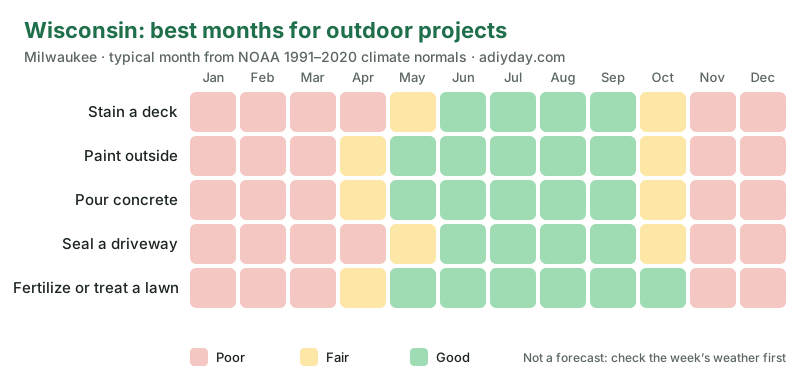
Wisconsin weather and outdoor projects
Wisconsin has cold winters and warm summers, with Lake Michigan cooling springs near the shore. Milwaukee is a little milder than Green Bay and the north, where frost comes early in fall and the outdoor season is shorter.
June through early September is the best window for staining, painting and concrete. Spring can be cool and wet, especially near the lake. Hard freezes begin in October, and long winters with freeze-thaw cycles and road salt are hard on concrete, so curing and sealing new flatwork matters.
Frost dates in Wisconsin
In Milwaukee, the median last spring freeze (32°F) is around April 19 and the median first fall freeze is around October 29, a frost-free season of about 192 days.
In Green Bay, the median last spring freeze (32°F) is around April 30 and the median first fall freeze is around October 9, a frost-free season of about 161 days.
Frost dates matter for concrete, which must not freeze in its first 48 hours, for paint and caulk that need nights above their minimum, and for lawn care, since crabgrass preventer goes down as the soil warms in spring. See how late in fall you can stain, paint or seal.
Best time to stain a deck in Wisconsin
In Milwaukee, the most reliable months are June–September. May and October can also work on the right days. November–April is too cold, with average highs around 41°F. In May, nights average about 48°F, so finish early on mild days and check the overnight low. October is cool, with highs around 61°F, so choose the warmest afternoons.
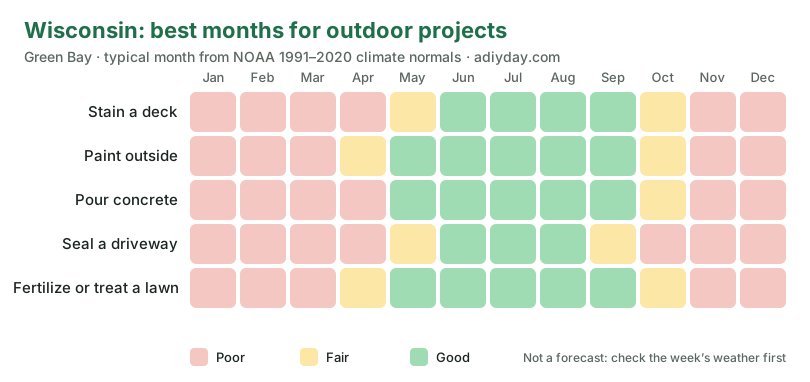
In Green Bay, the most reliable months are June–September. May and October can also work on the right days. November–April is too cold, with average highs around 37°F. In May, nights average about 46°F, so finish early on mild days and check the overnight low. October is cool, with highs around 58°F, so choose the warmest afternoons.
Check this week’s hour-by-hour verdict with the deck staining forecast.
Best time to paint outside in Wisconsin
In Milwaukee, the most reliable months are May–September. April and October can also work on the right days. November–March is too cold, with average highs around 39°F. April is cool, with highs around 55°F, so choose the warmest afternoons. In October, nights average about 45°F, so finish early on mild days and check the overnight low.
In Green Bay, the most reliable months are May–September. April and October can also work on the right days. November–March is too cold, with average highs around 34°F. April is cool, with highs around 54°F, so choose the warmest afternoons. In October, nights average about 40°F, so finish early on mild days and check the overnight low.
Check this week’s hour-by-hour verdict with the exterior painting forecast.
Best time to pour concrete in Wisconsin
In Milwaukee, the most reliable months are May–September. April and October can also work on the right days. November–March averages about 23 nights a month at or below 32°F, so fresh concrete needs blankets or heated enclosures. April and October bring about 4 freezing nights a month, so pick a mild spell and keep curing blankets on hand.
In Green Bay, the most reliable months are May–September. October can also work on the right days. November–April averages about 24 nights a month at or below 32°F, so fresh concrete needs blankets or heated enclosures. October brings about 8 freezing nights a month, so pick a mild spell and keep curing blankets on hand.
Check this week’s hour-by-hour verdict with the concrete pouring forecast.
Best time to seal a driveway in Wisconsin
In Milwaukee, the most reliable months are June–September. May and October can also work on the right days. November–April is too cold, with average highs around 41°F. May and October are cool, with highs around 64°F, so choose the warmest afternoons.
In Green Bay, the most reliable months are June–August. May and September can also work on the right days. October–April is too cold, with average highs around 40°F. May is cool, with highs around 67°F, so choose the warmest afternoons. In September, nights average about 50°F, so finish early on mild days and check the overnight low.
Check this week’s hour-by-hour verdict with the driveway sealing forecast.
Best time to fertilize or treat a lawn in Wisconsin
In Milwaukee, the most reliable months are May–October. April can also work on the right days. November–March is too cold, with average highs around 39°F. April is cool, with highs around 55°F, so choose the warmest afternoons.
In Green Bay, the most reliable months are May–September. April and October can also work on the right days. November–March is too cold, with average highs around 34°F. April and October are cool, with highs around 56°F, so choose the warmest afternoons.
Check this week’s hour-by-hour verdict with the lawn fertilizer forecast.
How the weather differs across Wisconsin
| Place | Hottest month avg high | Coldest month avg low | Rain per year | Last spring freeze | First fall freeze |
|---|---|---|---|---|---|
| Milwaukee | 82°F | 17°F | 35 in | April 19 | October 29 |
| Green Bay | 81°F | 11°F | 32 in | April 30 | October 9 |
Monthly weather in Milwaukee
| Month | Avg high | Avg low | Wet days* | Rain | 3 PM humidity | Freezing nights |
|---|---|---|---|---|---|---|
| January | 31°F | 17°F | 5 | 1.8 in | 64% | 28 |
| February | 34°F | 20°F | 4 | 1.7 in | 61% | 25 |
| March | 44°F | 29°F | 5 | 2.2 in | 56% | 21 |
| April | 55°F | 38°F | 7 | 3.9 in | 53% | 6 |
| May | 67°F | 48°F | 7 | 3.5 in | 55% | 0 |
| June | 77°F | 58°F | 7 | 4.4 in | 57% | 0 |
| July | 82°F | 65°F | 6 | 3.4 in | 57% | 0 |
| August | 80°F | 64°F | 6 | 3.6 in | 59% | 0 |
| September | 74°F | 56°F | 5 | 3.2 in | 58% | 0 |
| October | 61°F | 45°F | 6 | 2.8 in | 56% | 2 |
| November | 48°F | 33°F | 5 | 2.2 in | 59% | 15 |
| December | 36°F | 23°F | 5 | 1.9 in | 65% | 25 |
*Days with at least 0.1 inch of rain or melted snow. Freezing nights: average nights a month at or below 32°F. Humidity is calculated from NOAA hourly normal temperature and dew point at 3 PM.
Monthly weather in Green Bay
| Month | Avg high | Avg low | Wet days* | Rain | 3 PM humidity | Freezing nights |
|---|---|---|---|---|---|---|
| January | 26°F | 11°F | 4 | 1.4 in | 67% | 30 |
| February | 29°F | 13°F | 4 | 1.2 in | 62% | 27 |
| March | 40°F | 24°F | 5 | 2.0 in | 57% | 25 |
| April | 54°F | 35°F | 7 | 3.0 in | 50% | 12 |
| May | 67°F | 46°F | 7 | 3.4 in | 50% | 1 |
| June | 77°F | 56°F | 8 | 4.1 in | 55% | 0 |
| July | 81°F | 60°F | 7 | 3.6 in | 55% | 0 |
| August | 79°F | 58°F | 6 | 3.4 in | 57% | 0 |
| September | 72°F | 50°F | 6 | 3.2 in | 56% | 1 |
| October | 58°F | 40°F | 6 | 2.7 in | 56% | 8 |
| November | 44°F | 29°F | 5 | 2.0 in | 61% | 21 |
| December | 31°F | 18°F | 5 | 1.8 in | 69% | 28 |
Use the averages, then check the forecast
These ratings describe a typical month, not a particular week. A warm spell in a “poor” month can give you a good day, and a wet week can spoil a “good” one. Use this page to plan the season, then check the 7-day forecast for your ZIP code before you buy materials or book help. Each project forecast checks the hours after you finish too: overnight lows, dew and rain that would ruin fresh stain, paint, sealer or concrete.
About this data
Monthly temperatures, rain days, snowfall and freeze dates are NOAA National Centers for Environmental Information (NCEI) U.S. Climate Normals for 1991–2020 at MILWAUKEE MITCHELL AP, GREEN BAY. Ratings apply the same temperature limits as our forecasts (for example, 50°F or warmer for deck stain and driveway sealer, and no freezing nights for new concrete) to the average month. Your product label always takes priority.
Frequently asked questions
When is the best time to stain a deck in Wisconsin?
In Milwaukee, June–September. In Green Bay, June–September. Look for at least 24 dry hours before and after, and nights above about 40°F. The deck staining forecast checks your exact week.
When is the last frost in Wisconsin?
Milwaukee: around April 19; Green Bay: around April 30. These are median dates from NOAA 1991–2020 normals, so a freeze after them happens in about half of years. Low spots and valleys freeze later in spring.
Can you pour concrete in winter in Wisconsin?
Yes, but it needs cold-weather practices. Milwaukee averages about 79 freezing nights from December to February, so fresh concrete needs insulated blankets, a heated enclosure or an accelerated mix, and must not freeze in the first 48 hours. Many homeowners wait for spring.
What months are best for sealing a driveway in Wisconsin?
In Milwaukee, June–September. In Green Bay, June–August. Most sealers need 50°F or warmer for 24 hours and a dry day after. See the driveway sealing forecast.