
How Hot Is Too Hot to Paint, Stain or Pour Concrete? Heat, Sun and Humidity Limits for Every Outdoor Project
Most weather advice for outdoor projects is about cold and rain. In much of the U.S. the summer problem is the opposite: a 95°F afternoon that makes deck stain flash-dry, a humid Gulf Coast morning that leaves fresh paint streaked with brown drips, or a hot, breezy day that cracks a new slab before the finisher is done. This guide gives the actual limits for ten common jobs, explains what heat, sun and humidity do to each one, and shows how to find the hours that work near you.
The short answer
For most paint, stain, epoxy and spray paint, above 85°F is pushing it and above 90°F is too hot, and that is the temperature of the surface, not just the air. A wall or deck in full sun can be 20°F or more hotter than the forecast high. For humidity, under about 75% is good, and above 85% is too humid for paint, stain, epoxy and spray paint. At 85% humidity the air is only about 5°F above the dew point, so dew is close. Concrete is the exception: hot, dry and windy air is the risk, because the surface loses water too fast. To see which hours pass every check for your ZIP code, use the free A DIY Day 7-day project forecast.
How hot is too hot? Limits by project
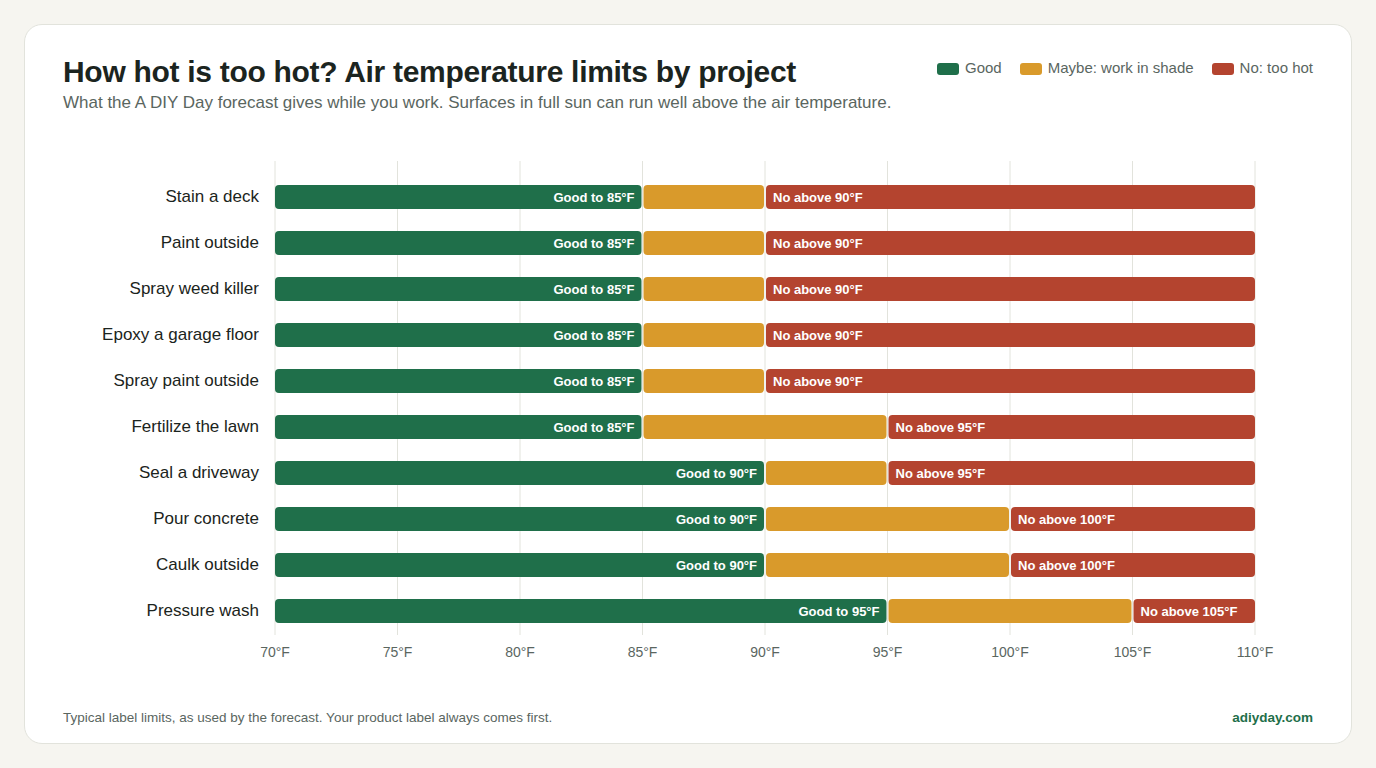
These are the upper temperature limits the A DIY Day forecasts use while you work. They come from typical product labels and technical data sheets and, for concrete, from the American Concrete Institute’s hot-weather guide (ACI 305). Up to the “Good” figure the day can still be a Good. Above it, the forecast gives a Maybe and tells you to work in the shade because the product may dry too fast. Above the “No” figure it calls the day a No. Click any project for its 7-day forecast.
| Project | Good up to | Maybe (work in shade) | No above | What goes wrong in heat |
|---|---|---|---|---|
| Stain a deck | 85°F | 86–90°F | 90°F | Flash-dries before it soaks in: lap marks, blotchy color, poor penetration |
| Paint outside | 85°F | 86–90°F | 90°F | Dries before it levels: lap marks, brush marks, weak bond, blistering on dark colors |
| Pour concrete | 90°F | 91–100°F | 100°F | Fast evaporation and setting: plastic shrinkage cracks, cold joints, lower strength |
| Seal a driveway | 90°F | 91–95°F | 95°F | Skins over on hot pavement before it bonds; streaks and early wear |
| Spray weed killer | 85°F | 86–90°F | 90°F | Some herbicides turn to vapor and drift; stressed weeds absorb less; turf can burn |
| Fertilize the lawn | 85°F | 86–95°F | 95°F | Burn risk on stressed or dormant grass, especially without watering in |
| Pressure wash | 95°F | 96–105°F | 105°F | Detergent dries on the surface before you rinse, leaving streaks |
| Epoxy a garage floor | 85°F | 86–90°F | 90°F | Short pot life: the batch hardens in the bucket, roller marks, bubbles |
| Caulk outside | 90°F | 91–100°F | 100°F | Joint is at its narrowest, so the bead is overstretched in winter |
| Spray paint outside | 85°F | 86–90°F | 90°F | Dry spray, rough or orange-peel texture, bubbling on hot metal |
The label on your product always wins. Some paints and stains allow up to 95°F or more, and some concrete mixes and admixtures are made for hot weather. The methodology page lists every temperature rule, including the overnight lows.
The forecast checks the hottest hour of each possible work window, then picks the best window of the day. So on a day that peaks at 96°F, it may still find a Good morning window for painting that ends before the heat builds. That is often the answer to “is it too hot today?”: not the whole day, just the afternoon.
How humid is too humid? Limits by project
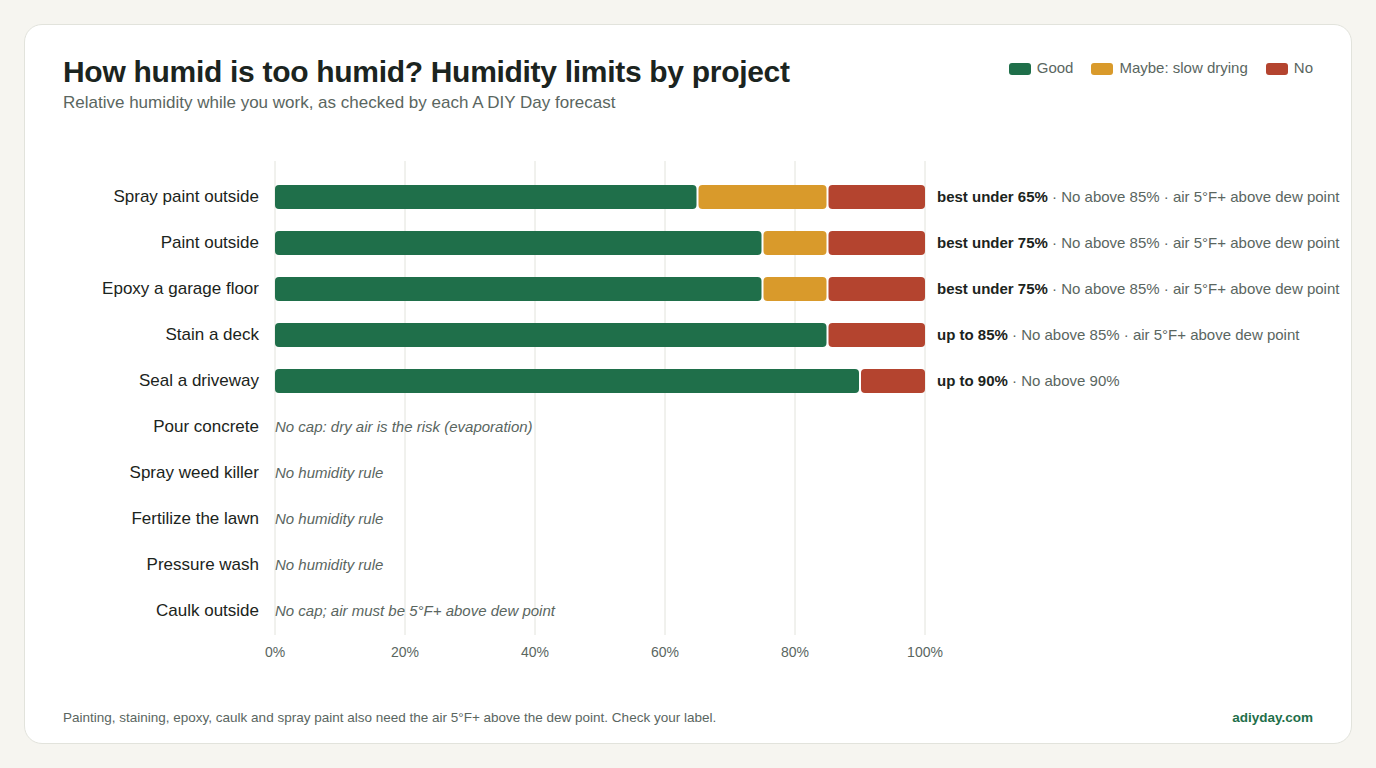
Humidity matters most for products that dry by evaporation or that can be damaged by moisture landing on them. Five projects have a humidity cap, and five check that the air stays far enough above the dew point for no moisture to condense on the surface while you work.
| Project | Best humidity | No above | Dew point gap | What goes wrong when it is damp |
|---|---|---|---|---|
| Stain a deck | up to 85% | 85% | air 5°F+ above dew point, no dew for 4 h after | Slow drying; evening dew spots and streaks fresh stain |
| Paint outside | under 75% | 85% | air 5°F+ above dew point, no dew for 4 h after | Slow drying; dew causes surfactant leaching (brown or sticky streaks) |
| Seal a driveway | up to 90% | 90% | — | Sealer stays soft longer, so rain and tires do more damage |
| Epoxy a garage floor | under 75% | 85% | air 5°F+ above dew point | Condensation on the slab, amine blush (a greasy film), poor adhesion |
| Caulk outside | no cap | — | air 5°F+ above dew point | Wet joints stop adhesion; latex caulk dries slower, silicone cures faster |
| Spray paint outside | under 65% | 85% | air 5°F+ above dew point | Blushing: a cloudy, milky or hazy finish |
Weed killer, fertilizer and pressure washing have no humidity rule. Damp air does them little harm, although weed killer still needs dry leaves (see how long to wait after rain).
What heat and sun do to a finish
Paint, stain, sealer and epoxy all need time in a liquid state to do their job. Stain has to soak into the wood. Paint has to flow out, level and fuse into a continuous film. Epoxy has to wet the concrete and release trapped air. Heat shortens that time, and direct sun shortens it more. The common results:
- Lap marks. The edge of the last section dries before you overlap it, so the overlap shows as a darker or glossier stripe. This is the most common heat problem with deck stain and exterior paint.
- Poor penetration. Stain that flash-dries on hot boards sits on the surface instead of soaking in, so it wears and peels sooner.
- Weak adhesion and film formation. Latex paint that dries too fast can form a weaker film. Labels that list a maximum temperature usually mean the surface as well as the air.
- Blistering. Sun heating a fresh coat, especially a dark color, can make solvent or moisture under the film expand into blisters.
- Short working time. Epoxy and driveway sealer get thicker and set faster in the heat, which leaves roller marks, bubbles and thin spots.
- Cracking in concrete. Water leaves the slab surface faster than it rises from inside, so the surface shrinks and cracks within hours. See hot-weather concrete below.
Heat has one benefit: it speeds curing once the finish is on, and warm nights are much better for curing than cold ones. The aim is to apply in moderate conditions and let the warm weather do the curing afterward. Cold has its own set of problems, covered in how late in the fall you can stain, paint or seal.
Can you paint or stain in direct sunlight?
You can, but it is best avoided on warm days, and that is what most labels say. The issue is surface temperature. A deck or a dark wall in full summer sun can run 20°F or more hotter than the air, so an 85°F afternoon can put the boards well past 100°F. The forecast uses air temperature because that is what the National Weather Service forecasts, which is why the “Maybe” band above 85°F tells you to work in the shade.
- Check the surface. An infrared thermometer costs little and settles the question. If the boards or siding are above your product’s maximum, wait or move to a shaded side. Surface temperature vs. air temperature explains how big the gap gets.
- Follow the shade around the house. East-facing walls get the morning sun and are shaded in the afternoon, west-facing walls the opposite. South-facing walls in the northern U.S. get sun most of the day in summer.
- Overcast is your friend. A bright overcast day in the 70s is close to perfect for paint and stain, as long as the rain chance stays low.
- Don’t wet wood to cool it before staining. Misting is fine for driveway sealer on asphalt, but water in the wood stops stain from soaking in.
How hot is too hot to paint outside?
What is the maximum temperature for exterior paint?
Most exterior latex paints list a maximum of about 90°F, and that is the limit the exterior painting forecast uses. It prefers 50–85°F. Some premium paints allow application into the mid-90s. Read the can, and remember the figure applies to the surface too.
Can you paint the house in 90-degree weather?
Only in the shade and the cooler hours, and with care. Keep a wet edge by painting one board or one section from end to end without stopping, work in shorter lengths, and don’t paint a wall the sun is about to reach. If the paint is drying on the brush or roller, stop. A paint extender or conditioner made for latex can add working time. Check that your paint maker allows it.
What is the best time of day to paint outside in summer?
Start once the morning dew has dried, usually mid-morning, and paint each side of the house after the sun has left it. The forecast looks for a 4-hour window starting between 9 AM and 1 PM, and on hot days the best window is often the earliest one. Don’t push into the evening to escape the heat: dew forms as the air cools, and dew on fresh latex is a common cause of surfactant leaching.
Hot weather and the rain after
Heat also brings afternoon thunderstorms in much of the East and South. Exterior paint needs 12 dry hours after you finish, and 24 is better. A clear 10 AM can turn into a 4 PM storm, so check the hourly rain chance, not just the daily one. How long does exterior paint need before it rains? covers what to do if it rains early.
Is it too hot to stain your deck?
What temperature is too hot to stain a deck?
The deck staining forecast allows up to 90°F and prefers 55–85°F. Deck boards in full sun are often the hottest surface around the house, because they face the sky all day. If the boards feel hot to your bare hand, they are too hot to stain.
Can you stain a deck in direct sun?
It is the classic cause of lap marks. Stain in the shade or on a bright overcast day. On a sunny day, start with the part of the deck the house shades in the morning and work toward the parts the sun reaches last. Stain two or three boards at a time along their full length so each board dries evenly.
Stain that dries too fast: what to do
- Work in smaller sections and keep a wet edge along the full length of each board.
- Back-brush right after spraying or rolling to work the stain into the wood.
- Apply thin coats. A heavy coat on hot wood dries on top and stays soft underneath.
- Stop by early afternoon on hot days, then finish the next morning from a board edge.
Summer is still a fine time to stain in many places. Just pick the morning, not the afternoon, and make sure the wood is dry. After a summer storm, the water drop test tells you when it is ready.
How hot is too hot to pour concrete?
There is no single air temperature. The American Concrete Institute’s hot-weather guide (ACI 305) treats hot weather as a combination of high air temperature, high concrete temperature, low humidity, wind and sun that can harm fresh or hardening concrete. The forecast handles this in two ways: a hard limit on air temperature (No above 100°F, Maybe above 90°F) and an hourly estimate of the evaporation rate.
The evaporation rate: why a breezy 80°F day can be worse than a still 95°F one
Plastic shrinkage cracks form when water evaporates from the surface faster than bleed water rises to replace it. ACI guidance says to take precautions as the evaporation rate approaches 0.2 lb/ft² per hour (1.0 kg/m² per hour). The forecast estimates it for every hour of the pour window from air temperature, humidity and wind using the Uno formula, a published equation version of the ACI chart, and warns when it passes that line.
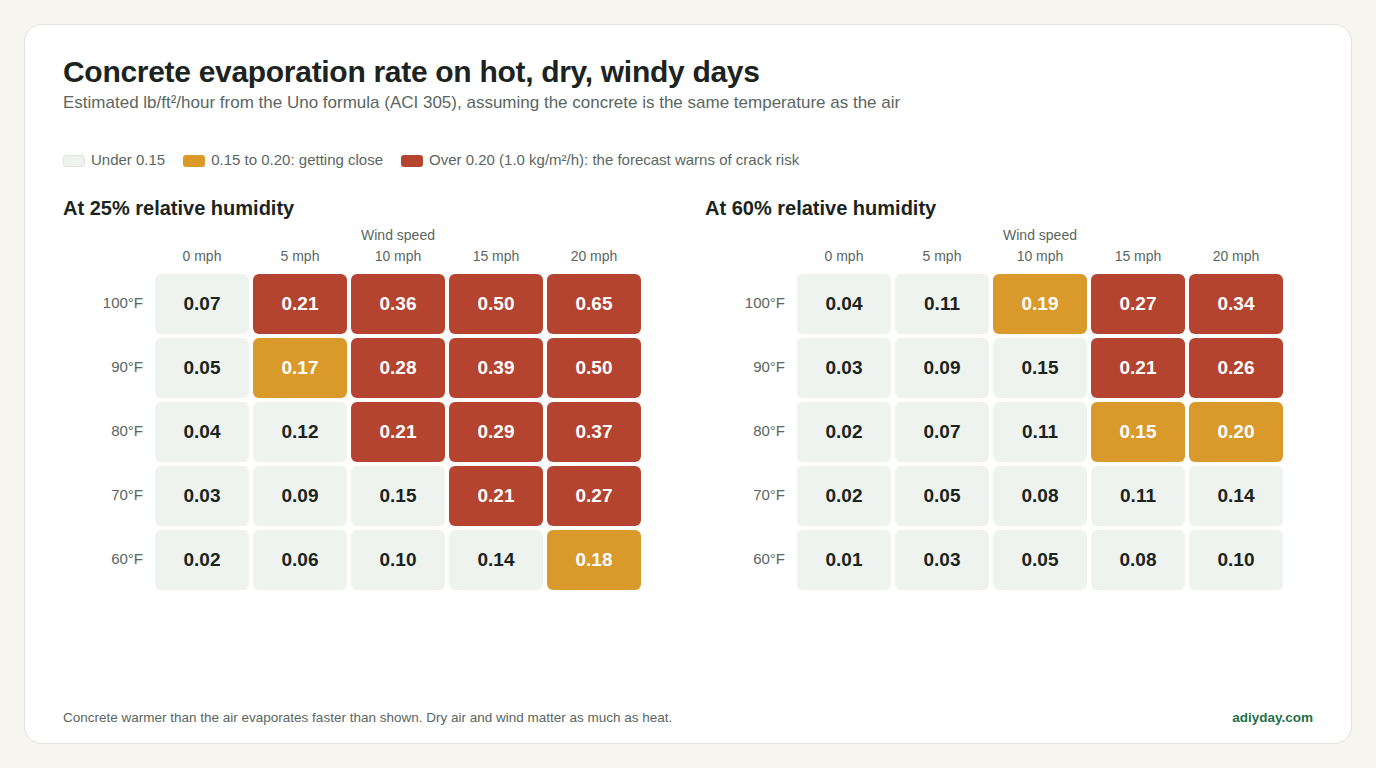
A few figures from that formula, assuming the concrete is the same temperature as the air:
- 80°F, 25% humidity, 10 mph wind: about 0.21 lb/ft²/h, over the line.
- 90°F, 60% humidity, 10 mph wind: about 0.15, under it.
- 100°F, 25% humidity, dead calm: about 0.07. Calm air helps a lot.
- 70°F, 25% humidity, 15 mph wind: about 0.21. A mild, dry, windy day can crack a slab.
Concrete warmer than the air, which is common in summer because the mix heats as it hydrates and sits in the sun, evaporates faster than these figures. Treat them as a floor, not a ceiling.
Hot-weather concreting tips
- Pour at first light. The forecast looks for a 4-hour window starting between 6 AM and noon, and on hot days the earliest window usually wins.
- Dampen the ground and forms before the pour so they don’t pull water from the mix, without leaving puddles.
- Block sun and wind with shades and windbreaks when you can.
- Fog the air above the slab or use an evaporation retarder between finishing passes. Never sprinkle water on the surface to finish it.
- Ask the supplier about a hot-weather mix: cooler mix water and a set retarder are common.
- Start curing right after finishing with curing compound, wet burlap or plastic, and keep it moist.
The concrete pouring forecast runs all of these checks for the next 7 days. Pouring concrete in hot or cold weather goes deeper into both ends of the range.

Sealing a driveway in hot weather
How hot is too hot to seal a driveway?
The driveway sealing forecast allows up to 95°F and prefers 60–90°F. Warmth and sun help asphalt sealer cure, which is why it is a summer job. The risk on very hot days is that black asphalt in full sun gets far hotter than the air, and sealer can skin over before it bonds.
Should you wet the driveway before sealing?
Many sealer labels say to lightly mist a hot driveway with a garden hose to cool it, then apply once there are no puddles. Follow your pail. This is the opposite of deck stain, which needs dry wood.
Humidity and driveway sealer
Sealer dries by evaporation, so humid air slows it. The forecast allows humidity up to 90% but still needs 24 dry hours after you finish and temperatures at or above 50°F for 24 hours. In humid weather, give it the 48 hours the forecast prefers before driving on it.
Garage floor epoxy in summer heat and humidity
Summer is a popular time to coat a garage floor, and it is also when most DIY epoxy problems happen. The garage floor epoxy forecast prefers 60–85°F, allows up to 90°F, wants humidity under 75% (No above 85%) and needs the air at least 5°F above the dew point.
- Pot life drops in heat. A common rule of thumb is that epoxy’s working time roughly halves for every 18°F (10°C) rise. A kit rated for 45 minutes at 77°F may give you much less in a 95°F garage. Mix smaller batches and pour each one onto the floor right away rather than leaving it in the bucket.
- Cool slab, humid air. On a humid summer day, a concrete slab that stayed cool overnight can be below the dew point of the air, so moisture forms on it. That causes poor adhesion and a cloudy finish.
- Amine blush. In damp conditions some epoxies form a waxy or greasy film on the surface. It has to be washed off before a topcoat will stick.
- Close up for the night. Keep the garage door down so blowing dust and evening moisture stay off the fresh coat.
Check the slab with an infrared thermometer and compare it with the dew point before you mix. The forecast uses outdoor air, and an attached garage can be warmer or cooler than that.
Spray paint in heat and humidity
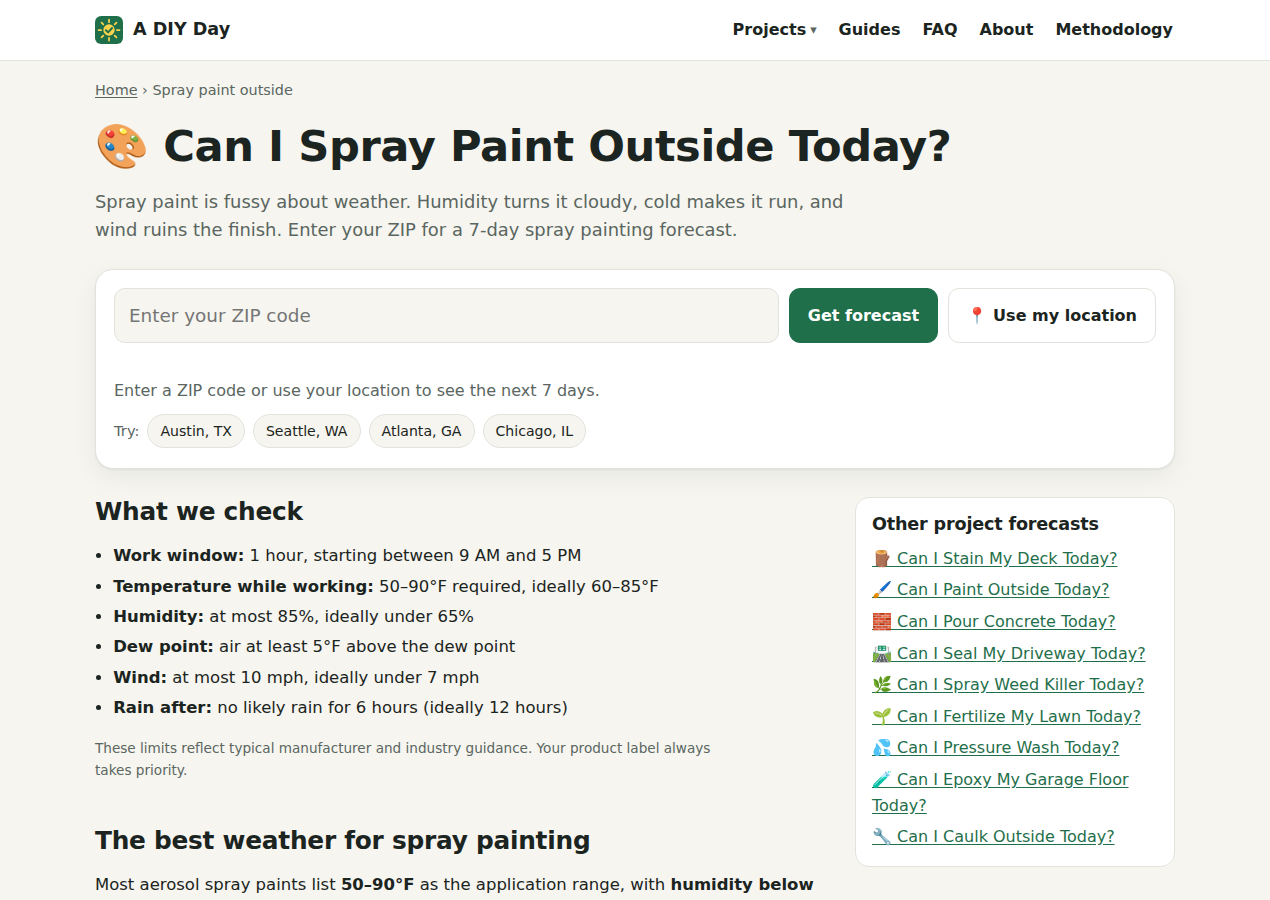
Spray paint is the most sensitive job here. The spray paint forecast wants 60–85°F, humidity under 65% and wind under 7 mph for a Good, and calls the day a No above 90°F or 85% humidity.
Why does spray paint turn cloudy in humidity?
The fast-evaporating solvents in aerosol paint cool the wet film. In humid air that cooling can drop the surface below the dew point, so tiny drops of water condense into the paint and leave a milky, hazy or cloudy finish. This is called blushing. Wait for a drier day, or spray mid-morning to early afternoon when humidity is usually at its lowest.
Can you spray paint in hot weather?
Up to the can’s limit, usually around 90°F, but not on parts sitting in the sun. Metal in direct sun can get hot enough that paint dries before it hits the surface (dry spray), giving a rough texture, or bubbles as it lands. Spray in the shade and let the part cool to air temperature first. Keep cans out of the sun and a hot car: they are pressurized.
Weed killer and fertilizer in hot weather
Is it too hot to spray weed killer?
The weed killer forecast prefers 60–85°F and allows up to 90°F. Above that, some herbicides, especially ester forms of 2,4-D and some dicamba products, can turn to vapor and move onto plants you want to keep. Weeds stressed by heat and drought also take up less product, and many lawn weed killer labels say not to spray turf in high heat. Spray in the morning once the leaves are dry. Best weather to spray weed killer covers wind, rain and timing.
Can you fertilize your lawn in hot weather?
The lawn fertilizer forecast prefers 50–85°F and allows up to 95°F. The bigger question is the grass. Cool-season lawns such as fescue, bluegrass and ryegrass slow down or go semi-dormant in summer heat, and feeding them then can burn the lawn and helps weeds more than grass. Warm-season lawns such as Bermuda, zoysia and St. Augustine grow actively in summer and can be fed. In either case, water it in the same day if no light rain is coming. The forecast gives a bonus when 0.1 to 0.75 inch of rain is expected within 48 hours.
Pressure washing and caulking in the heat
Pressure washing is the most heat-tolerant job here. The pressure washing forecast is Good up to 95°F and allows 105°F. The catch is cleaner: house-wash and deck-wash detergents can dry on hot siding or boards before you rinse, leaving streaks. Wash the shaded side, work in smaller sections and keep the surface wet. If you are washing a deck to stain it, wash first and give the wood a day or two of dry weather.
Caulking is fine in heat up to the label limit, often around 100°F. The forecast prefers 50–90°F. In hot sun a joint is at its narrowest, because the materials around it have expanded, so a bead put in at midday on a hot wall will be stretched hard in winter. Caulk in the morning shade if you can. Latex and acrylic caulks dry by evaporation and slow down in humidity. Silicone and polyurethane sealants cure by reacting with moisture in the air, so they set up faster in humid weather. Either way the joint itself must be dry. More in what temperature can you caulk outside and on the caulking forecast.
Relative humidity, dew point and the 5°F rule
Relative humidity is how close the air is to holding all the water vapor it can at its current temperature. Dew point is the temperature at which that vapor starts to condense. When a surface is at or below the dew point, water forms on it, and that is what ruins fresh paint, stain and epoxy. The two numbers are tied together: the higher the humidity, the closer the air temperature is to the dew point.
Coating makers usually want the surface at least 5°F (3°C) above the dew point. The table below shows the gap between the air temperature and the dew point at common combinations. Bold cells are under 5°F, where the forecast flags a condensation risk.
| Relative humidity | Gap at 60°F | Gap at 70°F | Gap at 80°F | Gap at 90°F |
|---|---|---|---|---|
| 50% | 18.7°F (dew point 41°F) | 19.5°F (dew point 50°F) | 20.3°F (dew point 60°F) | 21.1°F (dew point 69°F) |
| 60% | 13.9°F (dew point 46°F) | 14.5°F (dew point 55°F) | 15.1°F (dew point 65°F) | 15.8°F (dew point 74°F) |
| 70% | 9.8°F (dew point 50°F) | 10.2°F (dew point 60°F) | 10.7°F (dew point 69°F) | 11.1°F (dew point 79°F) |
| 75% | 8.0°F (dew point 52°F) | 8.3°F (dew point 62°F) | 8.6°F (dew point 71°F) | 9.0°F (dew point 81°F) |
| 80% | 6.2°F (dew point 54°F) | 6.5°F (dew point 64°F) | 6.7°F (dew point 73°F) | 7.0°F (dew point 83°F) |
| 85% | 4.5°F (dew point 55°F) | 4.7°F (dew point 65°F) | 4.9°F (dew point 75°F) | 5.1°F (dew point 85°F) |
| 90% | 2.9°F (dew point 57°F) | 3.1°F (dew point 67°F) | 3.2°F (dew point 77°F) | 3.3°F (dew point 87°F) |
| 95% | 1.4°F (dew point 59°F) | 1.5°F (dew point 68°F) | 1.6°F (dew point 78°F) | 1.6°F (dew point 88°F) |
Dew points calculated with the Magnus formula. Rounded to the nearest degree.
Two things stand out. First, at 85% humidity the gap is only about 4–5°F at any temperature, which is why 85% is the cap for paint, stain, epoxy and spray paint. Second, the gap depends on the surface, not the air. A slab, a shaded wall or metal that is cooler than the air can be at the dew point even when the air is not. That is why dew appears on cars and decks on clear nights while the air stays above the dew point.
Humidity also changes through the day. It is usually highest around dawn, when the air is coolest, and lowest in mid-afternoon. That daily cycle is why the forecasts start coatings mid-morning and want them to set before evening. The dew point guide shows how to read the dew point in a forecast and how to measure the surface.
Can you paint when it is humid?
What humidity is too high to paint outside?
The exterior painting forecast gives a Good under 75%, a Maybe from 76 to 85%, and a No above 85%. It also checks that the air stays at least 5°F above the dew point while you paint, and that dew is not likely within 4 hours of finishing. Many painters aim for roughly 40–70% humidity.
What happens if you paint in high humidity?
- Slow drying. Latex paint dries as its water evaporates, and humid air slows that. A coat that would be dry to the touch in an hour can take several.
- Surfactant leaching. When dew or high humidity hits latex paint before it sets, the soap-like additives come to the surface as tan, brown, white or sticky streaks. It usually washes off with mild soap and water once the paint has cured, and it is most common on dark colors and on paint applied late in the day.
- Poor adhesion if you paint over a surface with condensation on it.
Can you paint after rain or on a muggy morning?
Wait until the surface is dry to the touch, including the bottom edges of siding laps, and the humidity has dropped. On a muggy morning that often means starting after 10 AM. After a soaking rain, wood siding usually needs a day or two. How long after rain can you paint? gives the times by surface.
Does humidity affect how long paint takes to dry before rain?
Yes. Recoat and rain-ready times on paint cans usually assume about 77°F and 50% humidity. In humid weather, allow more. That is part of why the forecast needs 12 dry hours and prefers 24.
Can you stain a deck in high humidity?
The deck staining forecast allows humidity up to 85% while you work, with the air at least 5°F above the dew point and no dew likely within 4 hours of finishing. High humidity slows drying, so the stain stays soft longer and is more likely to be marked by evening dew, pollen or a passing shower. Water-based stains dry by evaporation, so humidity slows them most. Oil-based stains cure partly by reacting with air and are slowed more by cool temperatures.
In humid climates, stain on the driest day of the week, start after the morning dew has burned off, and stop early enough that the stain has several hours before evening. The deck also needs 24 dry hours after you finish, and the forecast prefers 48.
Best time of day to work in summer
Each forecast searches a set range of start times for the best window of the day. On hot days the earliest windows usually win, because the temperature check uses the hottest hour of the window.
| Project | Start between | Hot-day tip |
|---|---|---|
| Stain a deck | 9 AM to 2 PM | Start the first boards the sun has left; on a hot day the best window is often mid-morning |
| Paint outside | 9 AM to 1 PM | Follow the shade: west and north walls in the morning, east walls in the afternoon |
| Pour concrete | 6 AM to 12 PM | Pour at first light; have the crew, forms and curing ready before the truck arrives |
| Seal a driveway | 10 AM to 1 PM | Late morning once the pavement is dry; mist it if it is too hot to touch |
| Spray weed killer | 7 AM to 6 PM | Morning, once the dew is off and before the day passes 85°F |
| Fertilize the lawn | 7 AM to 6 PM | Early morning or evening, and water it in the same day |
| Pressure wash | 9 AM to 3 PM | Work in the shade and keep the surface wet so cleaner does not dry on it |
| Epoxy a garage floor | 9 AM to 1 PM | Morning, before the slab and garage heat up; mix small batches |
| Caulk outside | 9 AM to 4 PM | Morning in shade, when the joint is cooler and wider |
| Spray paint outside | 9 AM to 5 PM | Shade, mid-morning, with the part at air temperature |
Two things work against a very early start for coatings: morning dew and high humidity at dawn. That is why paint and stain windows start at 9 AM rather than sunrise. On a hot, humid day the best window is often a narrow one in mid-morning. How to read an hourly forecast shows how to find it yourself.
Hot-dry vs. hot-humid climates
Heat and humidity don’t always come together, and the difference changes which jobs are hard.
Hot and dry: the Southwest and inland West
Phoenix, Tucson, Las Vegas, El Paso, inland Southern California and the Central Valley routinely top 100°F in summer with low humidity. Humidity limits rarely matter there, but heat and evaporation do: paint and stain flash-dry, and concrete has some of the highest evaporation rates in the country, especially on windy afternoons. Most outdoor coating work moves to early mornings, and fall, winter and spring are often the best seasons. Arizona and New Mexico also get summer monsoon storms in the afternoon.
Hot and humid: the Southeast and Gulf Coast
Houston, New Orleans, Florida, Atlanta, Charlotte and much of the Southeast have long, humid summers with frequent afternoon thunderstorms. Heat is a problem, but humidity and dew are often the bigger limit for paint, stain, epoxy and spray paint. Mornings start damp, so the useful window is often late morning to early afternoon, before storms build. Check the hourly rain chance, not just the daily one. Fall and spring are usually the best painting and staining seasons.
Mixed: Texas, the southern Plains and the Midwest in summer
Dallas, Austin, San Antonio, Oklahoma City, Kansas City and St. Louis get both hot-dry and hot-humid spells, plus strong winds on the Plains. Heat waves push many days over the 90°F limit for paint and stain. Concrete crews start at dawn. Even northern cities like Chicago, Minneapolis and New York get summer heat waves with high humidity, when the same advice applies.
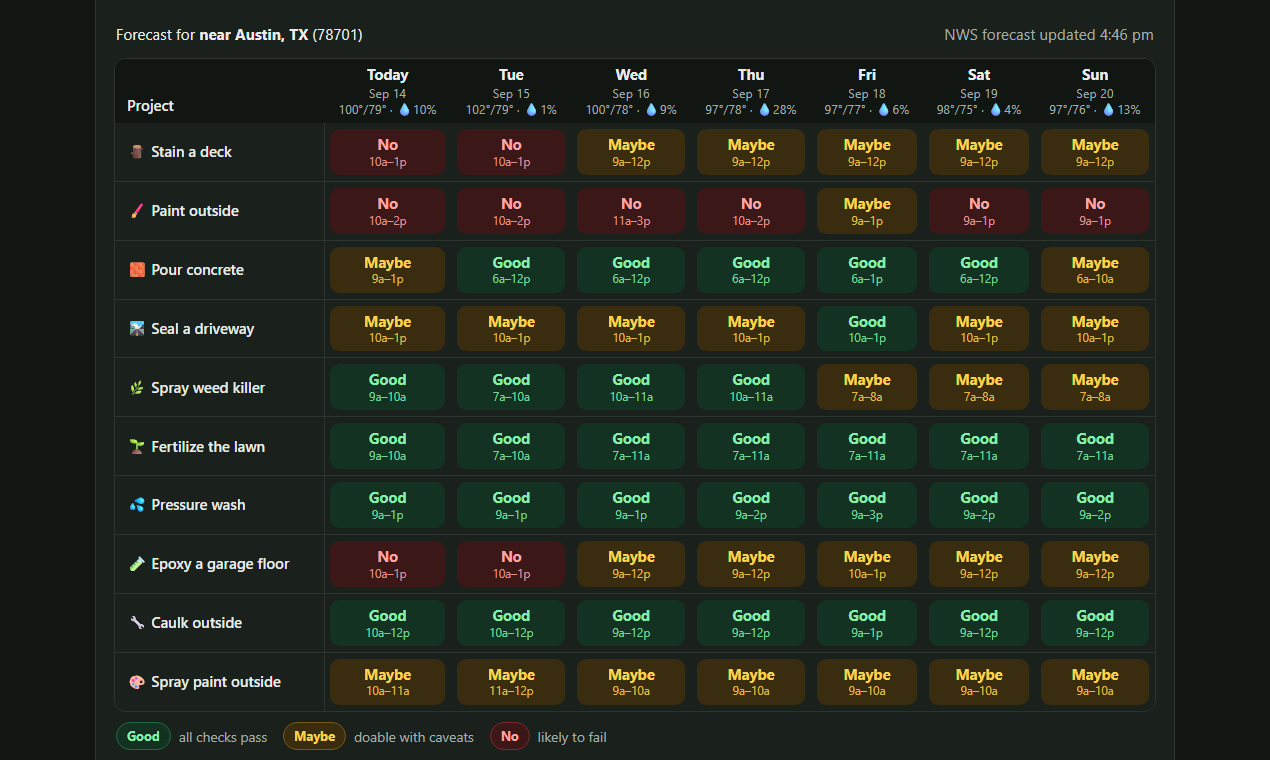
The Austin grid above is a good example of how a heat wave affects jobs differently. A day that is a No for paint can be a Good for pressure washing the deck or caulking the trim, so the week is not lost. The seasonal outdoor DIY calendar covers the best months by region.
Finding the right hours with A DIY Day
- Enter your ZIP code on the home page or tap “Use my location”. The forecast comes from the National Weather Service grid for your area.
- Scan the 7-day grid for the jobs you have in mind. In a heat wave, look for jobs that are Good when paint and stain are not.
- Open the project page. Each day shows the best window and the reasons for any Maybe or No, such as “Hot: 91°F at 2 PM — work in the shade; product may dry too fast” or “Humidity 88% at 10 AM (max 85%)”.
- Check again the evening before. Afternoon storms and heat peaks are easier to forecast a day out.
- Check the surface with your hand or an infrared thermometer before you open the can.
The full list of limits for every project is on the methodology page, and the complete guide to the best weather for outdoor projects covers cold, rain and the best time of year for each job.
Hot-weather mistakes that ruin projects
- Going by the forecast high instead of the surface. The deck or wall in sun can be far hotter than the air.
- Staining or painting the sunny side first. Follow the shade around the house instead.
- Escaping the heat by working in the evening. Dew forms as it cools, and fresh latex and stain don’t handle it well.
- Ignoring the afternoon storm. Hot, humid days often end with thunderstorms. Check the hourly rain chance for the hours after you finish.
- Mixing a full epoxy kit at once in a hot garage. Mix in smaller batches.
- Finishing concrete with added water. It weakens the surface. Use fog or an evaporation retarder instead.
- Feeding a dormant cool-season lawn in July. Wait for fall.
- Forgetting yourself. Take breaks, drink water and follow National Weather Service heat advisories. A rushed job in heat goes wrong anyway.
Hot-day checklist
- Check the project forecast for the best window and the reasons for any Maybe.
- Look at the hottest hour of that window and the hourly rain chance for the hours after.
- Read the label for the maximum temperature, and check whether it means air or surface.
- Measure the surface temperature. Plan to start on the shaded side.
- Check the dew point if it is humid. The surface should be at least 5°F above it.
- Have shade, water and a plan to stop at a clean edge if the heat or a storm arrives early.
Where these numbers come from: the limits are drawn from product labels and technical data sheets, ACI 305R (hot-weather concreting) and National Weather Service documentation. The methodology page lists every rule, and the FAQ answers the most common questions project by project.
Frequently asked questions
How hot is too hot to paint outside?
Most exterior latex paints list a maximum of about 90°F, and the surface counts as well as the air. The exterior painting forecast gives a Maybe above 85°F and a No above 90°F. Paint the side of the house the sun has left. See the hot-weather painting section.
Can you paint or stain in direct sunlight?
It is best avoided on warm days. A wall or deck in full sun can be 20°F or more hotter than the air, which causes lap marks and poor adhesion. Work in the shade or on an overcast day. Surface vs. air temperature explains the gap.
Is 90 degrees too hot to stain a deck?
It is at the limit. The deck staining forecast allows up to 90°F and prefers 55–85°F. At 90°F, stain in the morning shade, keep a wet edge along each board and stop before the boards get hot in the sun.
What humidity is too high to paint outside?
Above 85% is too humid for most exterior paint, and under about 75% is best. The air also needs to stay at least 5°F above the dew point. The humidity section explains what goes wrong when it is damp.
Can you paint when it is humid outside?
Yes, under about 85% humidity, if the surface is dry and dew is not likely for several hours after you finish. Expect slower drying. Paint late in the day in humid weather is the usual cause of surfactant leaching.
How hot is too hot to pour concrete?
There is no single number. The concrete forecast gives a Maybe above 90°F and a No above 100°F, and warns when the evaporation rate passes 0.2 lb/ft² per hour, which can happen at 80°F on a dry, windy day. See pouring concrete in hot or cold weather.
Can you seal a driveway when it is hot?
Yes, up to about 95°F. Warm, sunny weather helps sealer cure, but very hot pavement can make it skin over. Many labels say to mist the pavement lightly first. The driveway sealing forecast prefers 60–90°F.
Why does spray paint turn cloudy when it is humid?
The solvents cool the wet paint as they evaporate, and in humid air moisture condenses into it, leaving a milky finish called blushing. The spray paint forecast prefers humidity under 65% and calls a day No above 85%.
Can you epoxy a garage floor in summer?
Yes, but mix smaller batches because heat shortens pot life, and check that the slab is at least 5°F above the dew point on humid days. The garage floor epoxy forecast prefers 60–85°F and humidity under 75%.
Is it too hot to spray weed killer or fertilize?
Above about 85–90°F, some weed killers can vaporize and drift, and stressed weeds absorb less. The weed killer forecast calls a day No above 90°F. Cool-season lawns are best fed in fall, not in summer heat. See the lawn fertilizer forecast.
What is the best time of day to paint or stain in summer?
Mid-morning, after the dew has dried and before the hottest hours, on the side of the house the sun has already left. Avoid evenings, when dew forms. The summer timing table lists start times for each job.
Does humidity make paint take longer to dry?
Yes. Latex paint dries as its water evaporates, and humid air slows that, so recoat and rain-ready times on the can, which usually assume about 77°F and 50% humidity, get longer. How long paint needs before rain covers dry times.
Check the forecast for your project
Enter your ZIP code to see which of the next 7 days fit, hour by hour: stain a deck, paint outside, pour concrete, seal a driveway, spray weed killer, fertilize the lawn, pressure wash, epoxy a garage floor, caulk outside, spray paint outside.