
Best Weather for Outdoor Projects: Temperatures, Rain Times and the Best Day for Every DIY Job
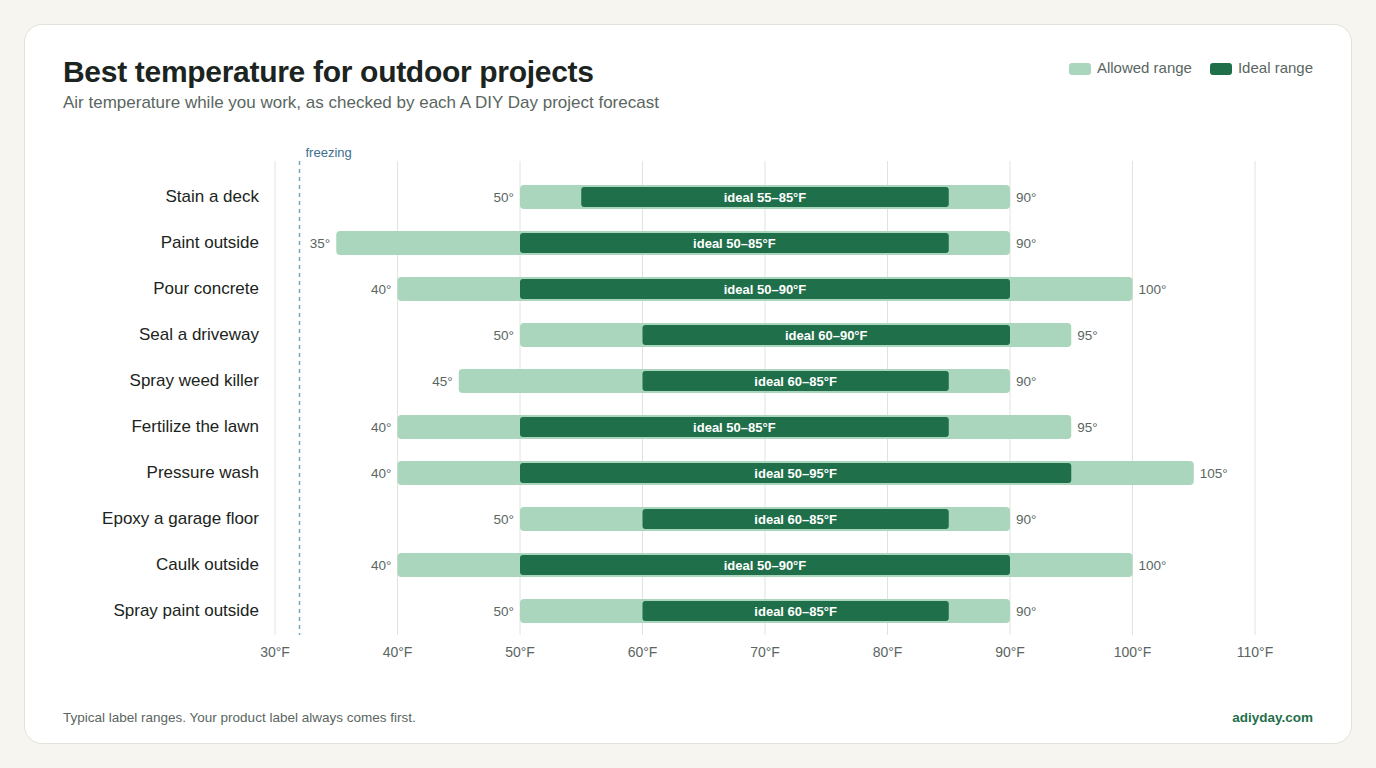
Search for “best weather to stain a deck” or “how cold is too cold to paint outside” and you get ten different answers, most of them ending with “check your local forecast.” This guide gives you the actual numbers for ten common outdoor jobs, explains why the hours after you finish matter as much as the hours you work, and shows how to find the right day near you with a free forecast that does the checking for you.
The short answer
Most outdoor coatings and sealers want a dry surface, 50–85°F while you work, humidity under about 85%, the air at least 5°F above the dew point, light wind, and a long dry stretch afterward: about 24 hours for deck stain and driveway sealer, 12 for exterior paint, 8 for fresh concrete and 6 for caulk, spray paint and weed killer. Nights matter too. A cold night or evening dew ruins more finishes than a cloudy afternoon. To check all of this for your ZIP code at once, use the free A DIY Day 7-day project forecast.
Best weather for outdoor projects: quick reference table
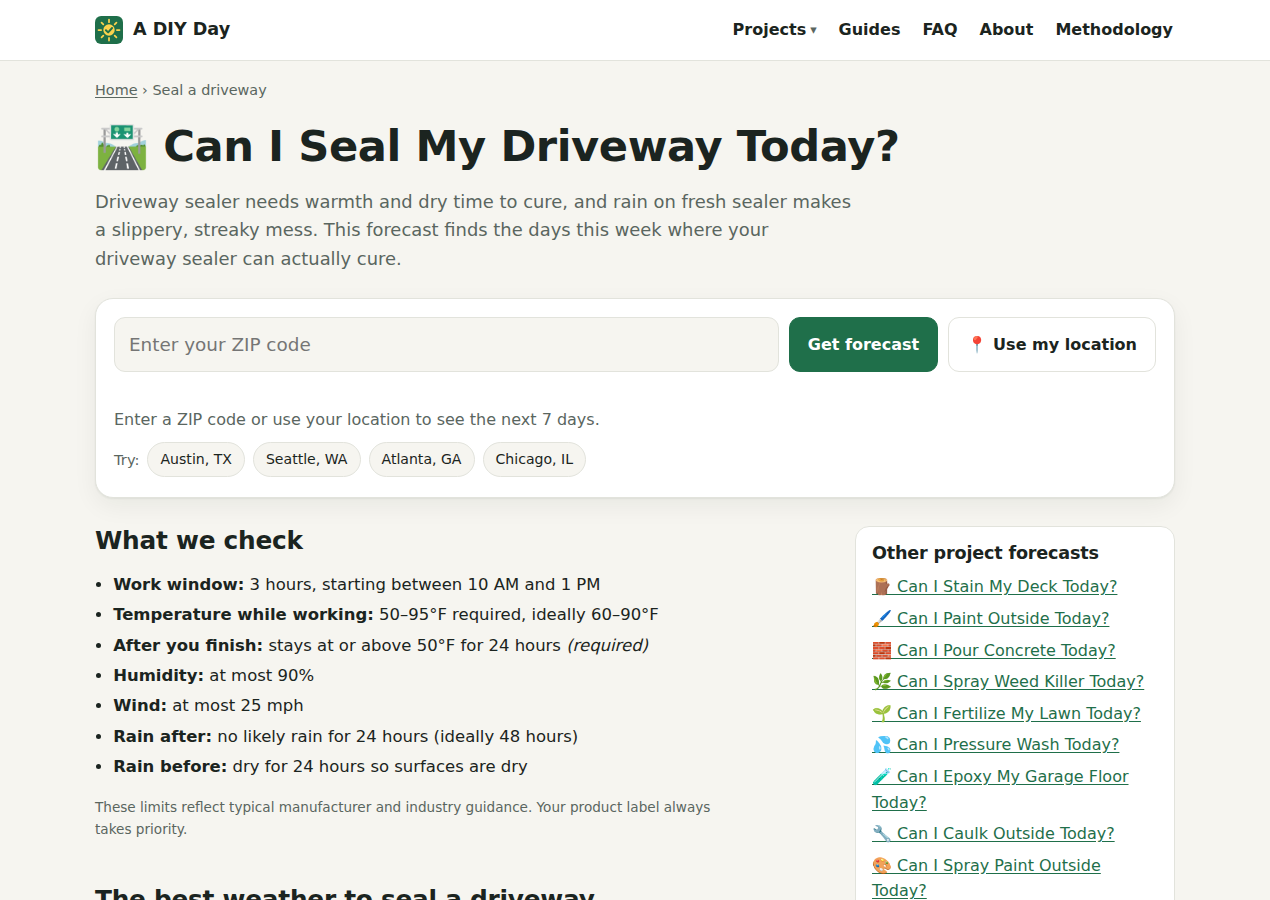
These are the limits the A DIY Day forecasts use for each job. They come from typical product labels and technical data sheets and, for concrete, from the American Concrete Institute’s hot- and cold-weather guides. “Best temperature” is the range where the forecast gives a clean Good. Outside it but inside the allowed range you get a Maybe with the reason. Outside the allowed range the day is a No. Click any project to see its 7-day forecast.
| Project | Best temperature | Allowed range | Must stay dry after | Overnight low after |
|---|---|---|---|---|
| Stain a deck | 55–85°F | 50–90°F | 24 h (48 h better) | 40°F+ for 12 h |
| Paint outside | 50–85°F | 35–90°F | 12 h (24 h better) | 35°F+ for 8 h |
| Pour concrete | 50–90°F | 40–100°F | 8 h (24 h better) | no freeze for 48 h |
| Seal a driveway | 60–90°F | 50–95°F | 24 h (48 h better) | 50°F+ for 24 h |
| Spray weed killer | 60–85°F | 45–90°F | 6 h | — |
| Fertilize the lawn | 50–85°F | 40–95°F | Light rain within 48 h helps; 1"+ in 24 h is a No | — |
| Pressure wash | 50–95°F | 40–105°F | No rain rule | ideally no freeze for 12 h |
| Epoxy a garage floor | 60–85°F | 50–90°F | No rain rule | 45°F+ for 24 h |
| Caulk outside | 50–90°F | 40–100°F | 6 h (24 h better) | — |
| Spray paint outside | 60–85°F | 50–90°F | 6 h (12 h better) | — |
The label on your product always wins. A low-temperature paint, a fast-setting concrete mix or a rain-ready stain can have different limits. The methodology page lists every rule, including humidity, dew point and wind.
What is A DIY Day (adiyday.com)?
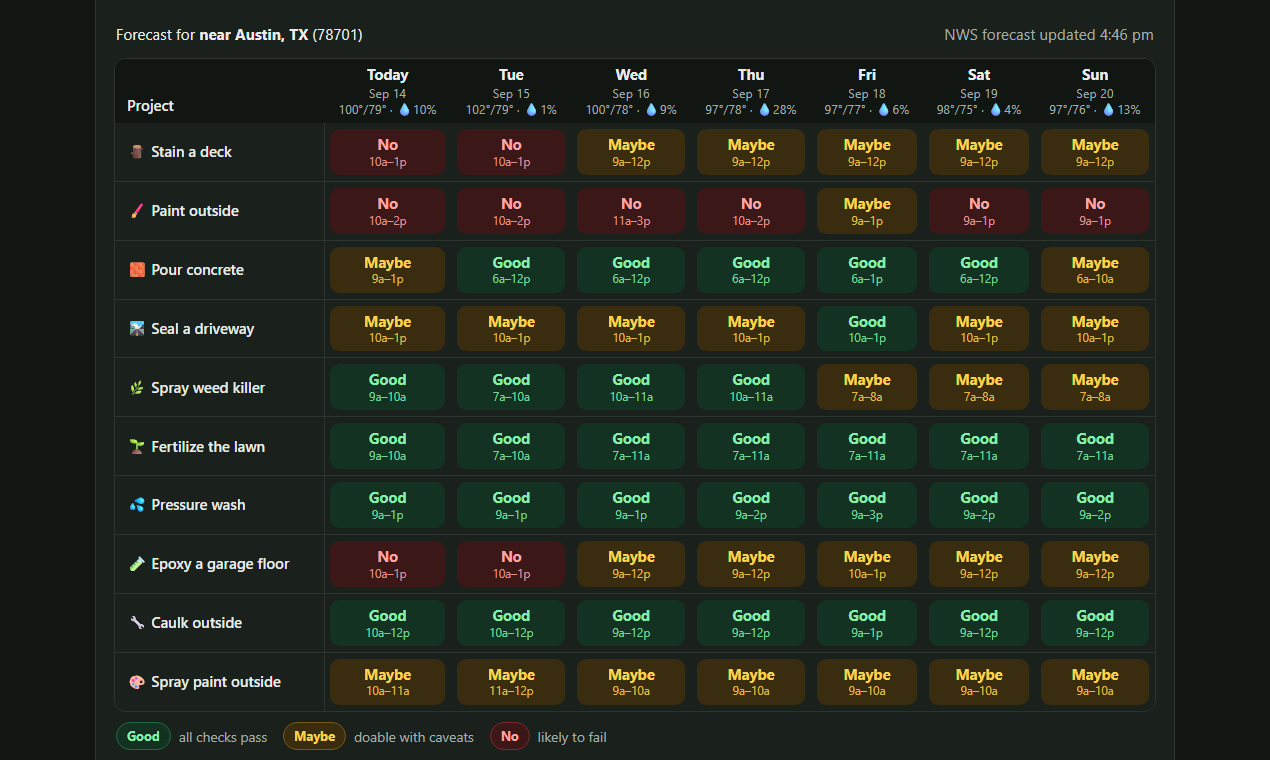
A DIY Day (adiyday.com) is a free outdoor project weather forecast for the United States. You enter a 5-digit ZIP code, or tap “Use my location”, and it reads the hourly forecast from the National Weather Service for your spot. It then scores each of the next 7 days for ten jobs: staining a deck, painting outside, pouring concrete, sealing a driveway, spraying weed killer, fertilizing the lawn, pressure washing, epoxying a garage floor, caulking and spray painting.
Each day gets a plain verdict, Good, Maybe or No, along with the best time window to start and the exact reason for anything that is not Good, such as “Rain likely by 6 PM, only 3 hours after you finish (needs 24 dry hours).” There is no account, no app to install and no charge. It works on a phone in the driveway as well as on a laptop the night before.
It is different from a normal weather app in one important way: it checks the weather for the job. A weather app will tell you it is 68°F and sunny on Saturday. A DIY Day might tell you Saturday is a No for deck stain because the temperature drops to 38°F that night, but a Good for pressure washing the deck so it can dry before you stain on Tuesday. Read more about who runs the site and where the rules come from on the About page.
Why a sunny day can still be the wrong day
Most failed outdoor projects did not fail while the work was being done. They failed in the hours that followed. Stain that peels in its first season, paint with brown streaks, driveway sealer that washed into the street and concrete with a cracked or flaky surface usually go back to one of these:
- Rain after you finish. A clear morning followed by a shower at 4 PM can wash out deck stain or driveway sealer that needed a full day to set. See what a 40% chance of rain really means.
- Dew in the evening. When the air cools close to its dew point, moisture settles on every surface. On fresh latex paint that leaves sticky brown streaks (surfactant leaching). The dew point guide shows how to check it.
- A cold night. Paint, stain, sealer and epoxy cure through chemistry that slows down sharply in the cold. A 70°F afternoon that drops to 35°F at night can leave a coating soft for days.
- A wet surface before you start. Yesterday’s rain can still be in the wood or concrete. See how long to wait after rain.
- Heat, sun and wind. They dry a finish too fast, leaving lap marks in stain and plastic shrinkage cracks in concrete. A deck in full sun can be far hotter than the air, as surface vs. air temperature explains. The heat and humidity guide gives the upper limits for every job.
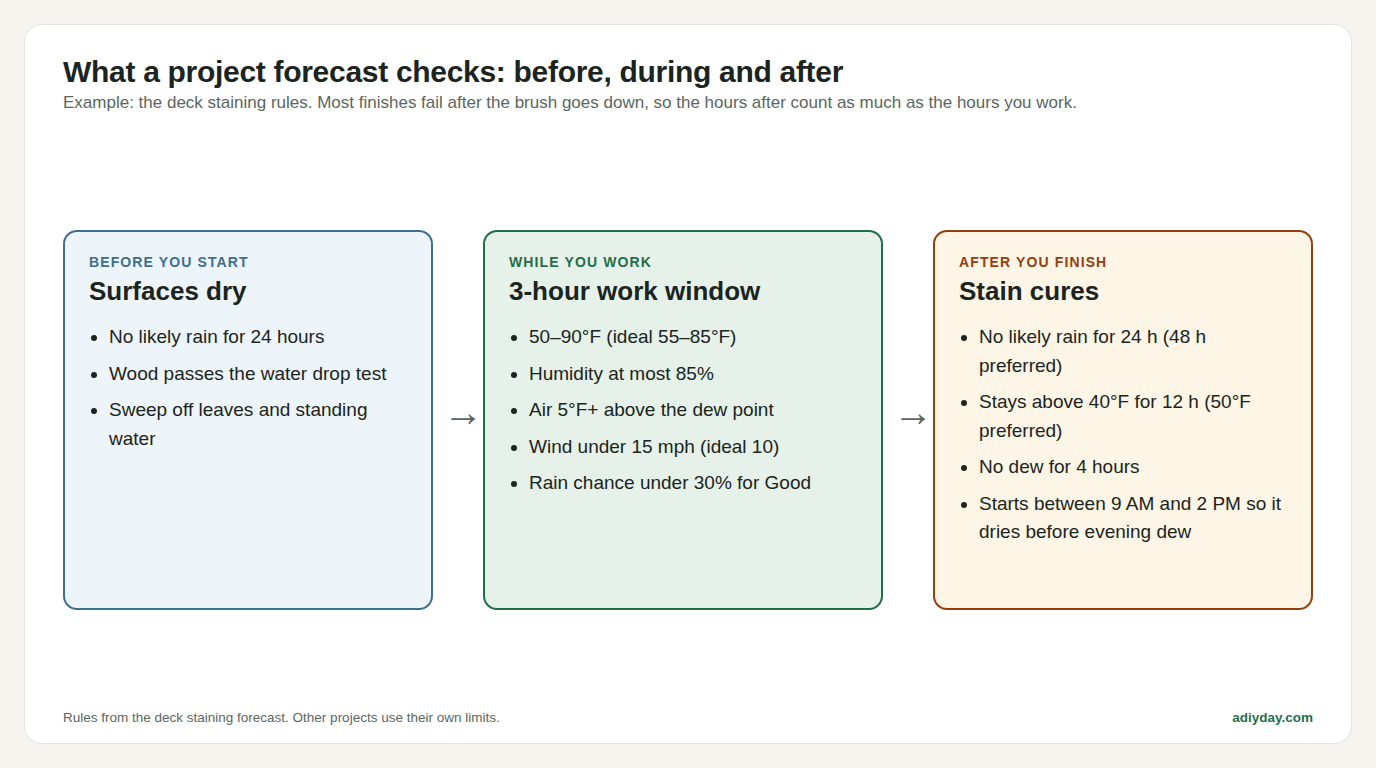
That is why every A DIY Day forecast scores three periods: before the work (is the surface dry?), during the work (temperature, humidity, dew point, wind, rain chance) and after the work (dry hours, overnight lows, dew). For a longer explanation of each factor, read the outdoor DIY weather timing guide.
Best weather to stain a deck
What is the best temperature to stain a deck?
Between 55 and 85°F while you work, with the air and boards no colder than 50°F and no hotter than about 90°F. The temperature should stay above 50°F for the 12 hours after you finish. The forecast calls a day No if it drops below 40°F in that time. Below 50°F most stains soak in slowly and stay tacky. Above 90°F, or on boards baking in full sun, the stain flash-dries before it penetrates and leaves lap marks.
How long does deck stain need to dry before rain?
Plan on 24 dry hours after you finish, and 48 if you can get them. Water-based stains are often dry to the touch in a few hours in warm weather. Oil-based stains can stay soft for a day or more, especially when it is cool or humid. A shower on stain that has not set leaves spots, streaks or a blotchy, washed-out look.
How long after rain can you stain a deck?
Usually one to two dry days after a light shower and two to three after a soaking rain. Shaded boards and the undersides dry last. Do the water drop test: sprinkle water on a few boards. If it soaks in within about a minute, the wood is ready. Is your deck dry enough to stain? covers the test and moisture meter readings.
What is the best time of year and time of day to stain a deck?
Late spring and early fall give most of the U.S. the longest run of good staining days: mild afternoons, lower humidity and nights above 50°F. Within the day, start after the morning dew has burned off and finish early enough to dry before evening dew. The forecast looks for a 3-hour window starting between 9 AM and 2 PM, with humidity at or below 85% and no dew in the 4 hours after you finish. Check your week on the deck staining forecast, and see how late in the fall you can stain.
Best temperature to paint outside
What temperature is too cold to paint outside?
For most standard exterior latex paint, below 50°F is too cold, and that includes the night after. Many premium paints are made for application down to 35°F, and the forecast allows that with a warning. It marks the day No if the temperature falls below 35°F within 8 hours of finishing, and Maybe if it falls below 50°F, so you know to use a low-temperature paint. Oil-based paints generally need 40–50°F or more. Check the can.
What is the best weather to paint a house exterior?
A dry day at 50–85°F, humidity under about 75% (85% at most), light wind and the air at least 5°F above the dew point. The hottest part of a summer afternoon is not ideal: paint dries too fast in direct sun and leaves lap marks, so follow the shade around the house. Most painters start on the west side in the morning and the east side in the afternoon.
How long does exterior paint need to dry before rain?
The forecast needs 12 dry hours after you finish and prefers 24. Many latex paints can handle a light shower after a few hours of warm, dry weather. Cool, humid weather stretches that out. How long does exterior paint need before it rains? goes through paint types and what to do if rain hits early.
Can you paint outside in high humidity or in the evening?
High humidity slows drying, and evening painting is the classic cause of dew damage on fresh latex. The forecast looks for a 4-hour window starting between 9 AM and 1 PM so the paint has the afternoon to set. The exterior painting forecast flags dew, humidity and cold nights for each day.
Best weather to pour concrete
How cold is too cold to pour concrete?
Fresh concrete can be permanently damaged if it freezes before it reaches about 500 psi, which usually takes around two days in cool weather (ACI 306). So the forecast marks a day No if it drops to freezing within 48 hours of the pour, and Maybe if lows fall below 40°F within 72 hours. The air should be at least 40°F while you pour, ideally 50°F or more. With insulated curing blankets, a cold-weather mix and warm ground a small pour is possible. Waiting for a better forecast is simpler for a DIY slab or fence posts. More in pouring concrete in hot or cold weather.
How hot is too hot to pour concrete?
Air temperature alone does not tell you. Concrete cracks in hot weather because water leaves the surface faster than it can bleed up from inside. The forecast estimates that evaporation rate each hour from temperature, humidity and wind (the Uno formula based on the ACI 305 chart) and warns when it passes 0.2 lb/ft² per hour. That is why a dry, breezy 80°F afternoon can crack a slab faster than a still, humid 88°F morning. Pour early: the forecast’s window starts between 6 AM and noon, and it caps the air temperature at 100°F.
Can you pour concrete in the rain?
Not while rain is falling on the surface you are finishing. Rain during placement weakens the surface and washes out the cream. The forecast wants 8 dry hours after the pour, and 24 is better. Keep plastic sheeting on hand in case a shower arrives early.
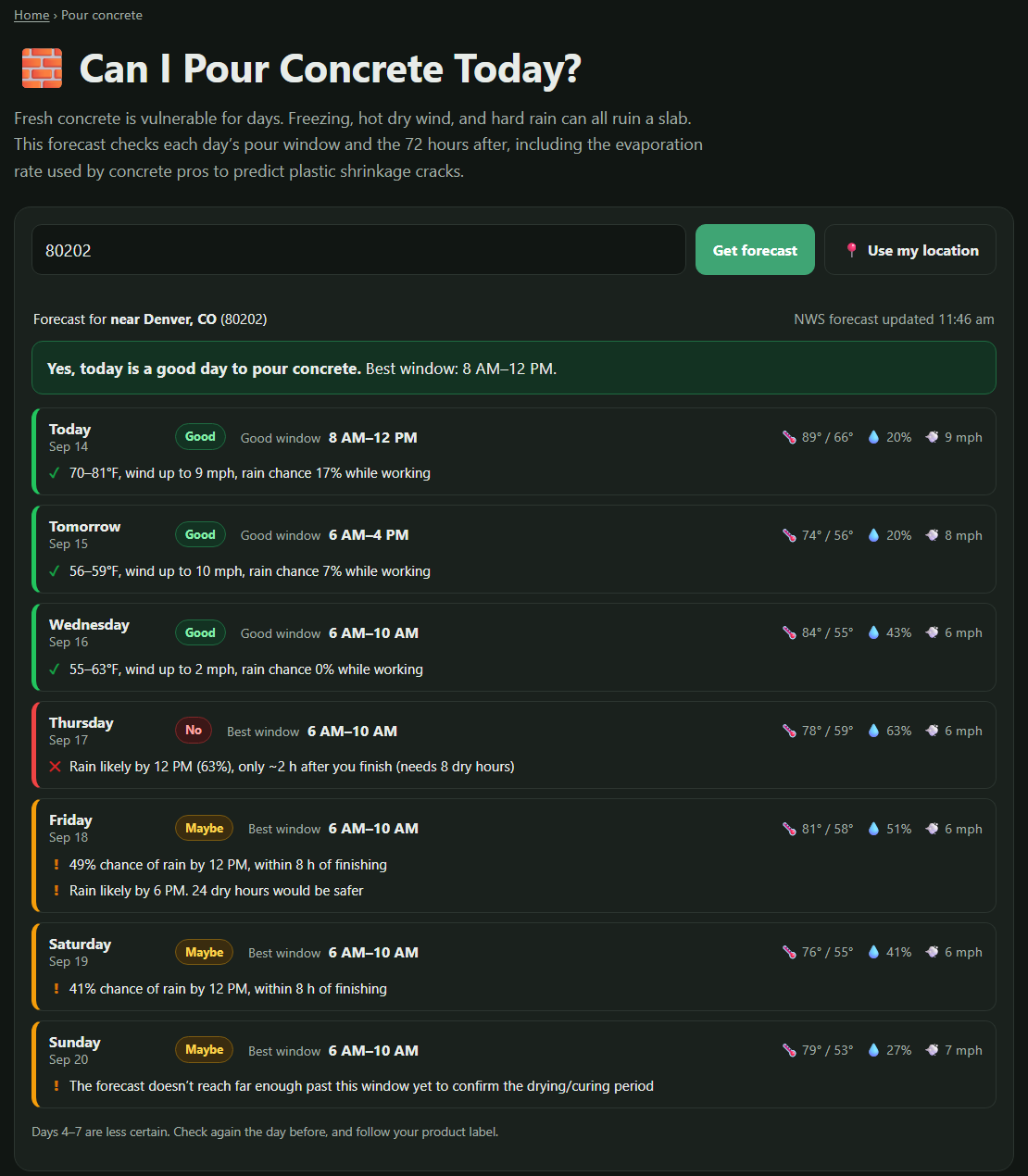
Check your own week on the concrete pouring forecast.
Best temperature to seal a driveway
What temperature do you need to seal a driveway?
Most asphalt driveway sealers say 50°F and rising during application and at least 50°F for the next 24 hours. That 24-hour rule is what the forecast checks, and a night below 50°F makes the day a No. The best results come at 60–90°F in sun with low humidity. Above about 95°F the pavement is so hot the sealer can skin over before it bonds. Lightly mist the surface on hot days.
What is the best time of year to seal a driveway?
Late spring through early fall in most of the U.S., when nights stay warm. In the North the season usually ends in September or October as nights cool. In the South it can run much longer. The time of day matters too: the forecast looks for a 3-hour window starting between 10 AM and 1 PM, so the pavement is warm and the sealer has the afternoon sun.
How long does driveway sealer need before rain, and when can you drive on it?
At least 24 dry hours, and 48 in cool, cloudy or humid weather. Rain on uncured sealer leaves streaks and a slippery film that can run into the street. Most products allow foot traffic after several hours and cars after 24–48 hours. The label is the rule. See the driveway sealing forecast.
Best weather to spray weed killer
What is the best temperature to spray weed killer?
Post-emergent weed killers work best on actively growing weeds at 60–85°F. The forecast allows 45–90°F. In the cold, weeds take the product up slowly. Above about 85°F some herbicides, such as ester forms of 2,4-D, can turn to vapor and drift onto plants you want to keep.
How long does weed killer need before rain?
It depends on the product. Rainfast times on labels range from under an hour to several hours. Planning for 6 dry hours covers most common products, and that is what the forecast checks. The leaves should also be dry when you spray, so it wants 3 dry hours before. Glyphosate products such as Roundup list their own rainfast time, so read the label for the exact figure. Best weather to spray weed killer explains rainfast times in more detail.
How windy is too windy to spray weeds?
Above about 10 mph, or gusts above 15 mph, spray drifts. Dead calm air is a problem too. Under about 3 mph there may be a temperature inversion that lets fine droplets hang and drift a long way. The ideal is a steady 3–10 mph breeze blowing away from your garden. The weed killer forecast checks wind, gusts and calm air hour by hour.
Best weather to fertilize your lawn
Should you fertilize before or after rain?
For granular fertilizer, just before a light rain is ideal. The forecast gives a bonus when 0.1 to 0.75 inch of rain is expected within 48 hours, because that waters the product in for you. It marks a day No if an inch or more is forecast within 24 hours, since heavy rain can wash fertilizer into gutters and storm drains. Some states and towns restrict fertilizing before heavy rain or on frozen ground.
What temperature is best for fertilizing a lawn?
The forecast looks for 50–85°F. Cool-season lawns (fescue, bluegrass, rye, common in the North) do best when fed in fall and spring. Warm-season lawns (Bermuda, zoysia, St. Augustine, common in the South) are fed while actively growing in late spring and summer. Pre-emergent crabgrass control is timed by soil temperature instead. See when to apply crabgrass preventer and the lawn fertilizer forecast.
Best weather to pressure wash
Pressure wash on a day above 40°F, ideally 50°F or more, with wind under about 15 mph. The rule that matters most is the night: if it freezes within 12 hours, water driven into wood, concrete cracks, siding laps and the pump itself can freeze, so the forecast marks the day Maybe. If you are washing a deck to stain it, wash first and give the wood one to two dry days before staining. Pressure washing in cold weather covers winter washing and storing the machine, and the pressure washing forecast finds the right day.
Garage floor epoxy temperature and humidity
Most garage floor epoxy kits want 60–85°F (50–90°F allowed), humidity under about 85%, and a slab at least 5°F warmer than the dew point so moisture does not form on it. The first night matters most: the forecast marks a day No if it drops below 45°F within 24 hours and Maybe below 55°F. Keep the garage door closed overnight. The forecast uses outdoor air, and a concrete slab is often cooler than the air, so check the floor with an infrared thermometer before you mix. See the garage floor epoxy forecast.
Best temperature to caulk outside
Most exterior latex, acrylic and hybrid caulks need 40°F or warmer and work best from 50 to 90°F. Some 100% silicone sealants go on below freezing if the joint is dry and frost-free. Caulk needs a dry joint, so the forecast wants 12 dry hours before and 6 dry hours after (24 preferred), with the air at least 5°F above the dew point. Caulking in mild weather has another benefit: the gap is mid-sized, so the bead is not stretched too far in winter or squeezed in summer. More in what temperature can you caulk outside and on the caulking forecast.
Best weather to spray paint outside
Most aerosol spray paints list 50–90°F and humidity below 85%. For a smooth finish aim for 60–85°F, humidity under about 65% and wind under 7 mph (10 at most). High humidity is the usual reason spray paint turns cloudy or milky (blushing). Work in shade: metal or plastic in direct sun can get hot enough to make the paint bubble. The forecast wants 6 dry hours after spraying. Check the spray paint forecast.
How long does each job need to stay dry?
People most often ask how long a job has to stay dry after they finish, so here are the dry times side by side. “Required” is what the forecast needs for a Good or Maybe. Rain likely (50% or higher, or measurable rain in the forecast amounts) in that period makes the day a No. “Preferred” is the extra time that turns a Maybe into a Good.
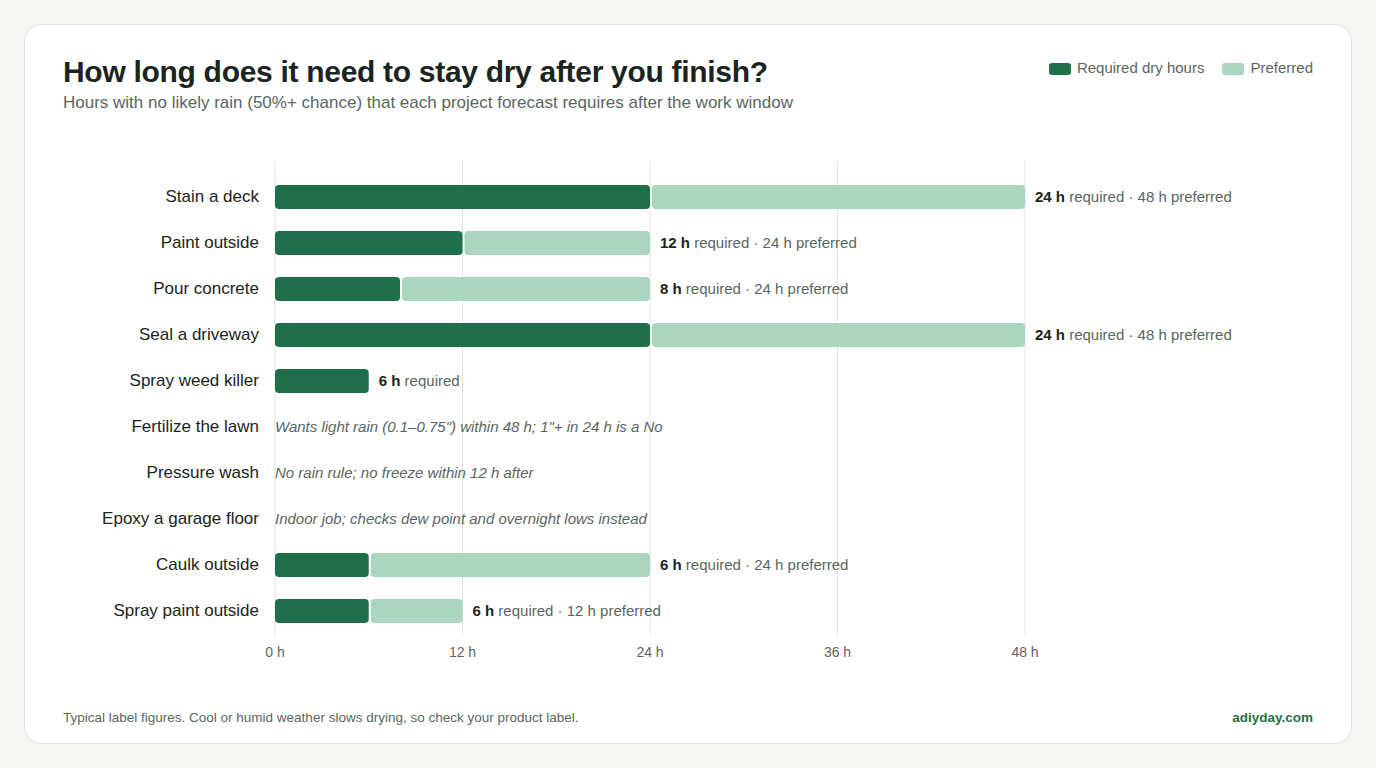
How the forecast reads the chance of rain: 30–49% during a period that must stay dry gives a Maybe, and 50% or higher gives a No. The National Weather Service defines that percentage as the chance that at least 0.01 inch falls at your location during that period, not the share of the area or the day that gets wet. The full explanation is in What does a 40% chance of rain mean?
Best time of day for outdoor projects
Each forecast searches for the best start time within a set window that suits the job, then reports the longest stretch that passes every check:
| Project | Work window | Start between |
|---|---|---|
| Stain a deck | 3 h | 9 AM to 2 PM |
| Paint outside | 4 h | 9 AM to 1 PM |
| Pour concrete | 4 h | 6 AM to 12 PM |
| Seal a driveway | 3 h | 10 AM to 1 PM |
| Spray weed killer | 1 h | 7 AM to 6 PM |
| Fertilize the lawn | 1 h | 7 AM to 6 PM |
| Pressure wash | 3 h | 9 AM to 3 PM |
| Epoxy a garage floor | 3 h | 9 AM to 1 PM |
| Caulk outside | 2 h | 9 AM to 4 PM |
| Spray paint outside | 1 h | 9 AM to 5 PM |
Coatings start mid-morning, after the dew has burned off, and finish by mid-afternoon so they can set before the evening dew. Concrete starts early to avoid afternoon heat and wind. Weed killer and fertilizer have long windows because the work is short. How to read an hourly forecast shows how to spot these windows yourself.
Best time of year for outdoor projects, region by region
The U.S. has very different project seasons. The same rules apply everywhere, but the months when they line up differ. These are broad patterns. Any given week can break them, which is why the day-by-day forecast matters more than the calendar. The seasonal outdoor DIY calendar goes month by month.
Northeast and Mid-Atlantic (New York, Pennsylvania, New England, New Jersey, Maryland, Virginia)
Late May through June and September into early October are the prime windows for staining, painting and sealing. Spring often starts wet, and the wood needs time to dry out after winter. In fall, nights below 50°F end the driveway sealing season first, then deck stain, then exterior paint. Summer heat waves bring humidity and late-day thunderstorms, so morning starts work best.
Southeast and Gulf Coast (Florida, Georgia, the Carolinas, Alabama, Louisiana)
Humidity and dew are the main limits (see how humid is too humid). Summer afternoons bring pop-up thunderstorms even when the daily rain chance looks low, so check the hourly forecast. Fall through spring is often the best painting and staining season. Concrete crews start early in summer, and freeze rules rarely matter except in occasional cold snaps.
Midwest and Great Plains (Illinois, Ohio, Michigan, Minnesota, Missouri, Kansas, Nebraska)
Short shoulder seasons and fast swings between warm and cold. A warm week in October can be followed by a hard freeze, so the 48-hour freeze check for concrete and the overnight lows for stain and sealer matter. Spring brings strong winds on the Plains, which limits spraying weed killer and spray painting.
Texas and the Southwest (Texas, Arizona, New Mexico, Nevada, Oklahoma)
Heat is the limit in summer (see how hot is too hot). Many days run above the 90°F maximum for stain, paint and epoxy, and concrete has high evaporation rates. Fall, winter and spring often have the best days in the low deserts. Arizona and New Mexico get a summer monsoon with afternoon storms. Higher-elevation areas have cold nights even after warm days.
Pacific Northwest (Washington, Oregon)
The dry summer, roughly July through September, is the main season for staining and exterior painting. From fall to spring, frequent drizzle, high humidity and slow-drying wood make long dry spells rare. Morning dew can last late, so starts after 10 AM are common even in summer.
California
Much of the state has a long dry season, so rain is less of a limit than in the East. Coastal fog and marine layer mornings bring high humidity and dew, and inland valleys get very hot in summer. Spring and fall are reliable almost everywhere.
Mountain West (Colorado, Utah, Idaho, Montana, Wyoming)
Dry air, strong sun and big swings between day and night. A 75°F afternoon can drop below 40°F at night, which matters for stain, sealer and epoxy. Low humidity and wind raise the evaporation rate for concrete. Afternoon thunderstorms are common in summer over the mountains.
A DIY Day works for any U.S. ZIP code covered by the National Weather Service, including Alaska and Hawaii. Everywhere, the best approach is the same: pick a likely day from the 7-day view, then check again the evening before.
How to find the best day with A DIY Day
- Enter your ZIP code on the home page or tap “Use my location”. The forecast comes from the National Weather Service grid for your area, not from the nearest airport.
- Scan the 7-day grid. The home page scores all ten projects for each day so you can plan a whole weekend, for example pressure wash on Saturday and stain on Monday.
- Open the project page for the job you are planning. You will see each day’s verdict, the best time window and every reason for a Maybe or No.
- Check again the evening before. Forecasts for the next 1–3 days are much more reliable than days 4–7.
- Check the surface and the label before you open the can: dry wood, a warm enough slab, and the product’s own limits.
A weather app vs. a project forecast
| Typical weather app | A DIY Day project forecast | |
|---|---|---|
| Answers | What the weather will be | Whether that weather works for a specific job |
| Hours checked | The hours you look at | Before, during and after the work, up to 72 hours after for concrete |
| Dew point | Listed, if you look for it | Compared with the air temperature for every work hour |
| Overnight lows | Shown for tonight | Checked against each product’s cure limit |
| Concrete evaporation | Not shown | Estimated each hour from temperature, humidity and wind |
| Result | Numbers and icons | Good, Maybe or No, a best window, and the reasons |
| Cost | Free or subscription | Free, no account |
Use both. The weather app is good for radar and alerts on the day. The project forecast tells you which day to pick.
Weather mistakes that ruin DIY projects
- Looking only at the daily high. The low that night decides whether stain, sealer and epoxy cure.
- Starting too late in the day. A 4 PM paint job meets the evening dew before it has set.
- Trusting a sunny surface after rain. Wood and concrete hold water below the surface. Test before you start.
- Staining or painting in full sun on a hot day. The surface can be much hotter than the forecast high.
- Ignoring wind. Breezy, dry weather cracks concrete and blows weed killer and spray paint off target.
- Planning a week out and not checking again. Days 4–7 are for planning. Confirm the day before.
- Going by a general rule instead of the label. Products differ. Low-temperature paints, rain-ready stains and fast-set concrete have their own limits.
The night-before checklist
- Recheck the project forecast for your ZIP code. Is tomorrow still Good, and what is the best start time?
- Look at the hours after you finish: rain chance, overnight low, dew.
- Read the product label: minimum temperature, recoat time and rain-ready time.
- Check that the surface is dry, especially shaded spots, low spots and undersides.
- Have a backup: a tarp, plastic sheeting or a plan to stop at a clean edge if a shower pops up.
Where these numbers come from: the rules are drawn from product labels and technical data sheets, the American Concrete Institute’s hot- and cold-weather concreting guides (ACI 305R and 306R), and National Weather Service documentation. The methodology page lists every limit, and the FAQ answers the most common timing questions project by project.
Frequently asked questions
What is the best weather for outdoor projects?
For most stains, paints and sealers: a dry surface, 50–85°F while you work, humidity under about 85%, the air at least 5°F above the dew point, wind under 10–15 mph, and a dry stretch after you finish (24 hours for deck stain and driveway sealer, 12 for exterior paint). The quick reference table gives the numbers for each job.
What is A DIY Day?
A DIY Day (adiyday.com) is a free 7-day weather forecast for outdoor home projects in the United States. Enter a ZIP code on the home page and it scores ten jobs, including deck staining, painting, concrete and driveway sealing, as Good, Maybe or No using the hourly National Weather Service forecast.
What is the best weather app for painting or staining?
A regular weather app shows the numbers. A project forecast checks them against the job. A DIY Day is free and checks temperature, humidity, dew point, wind and the rain and cold after you finish, for example on the exterior painting forecast and the deck staining forecast.
Can I stain my deck in 50 degree weather?
Yes, if it stays at 50°F or above while the stain dries and the boards are dry. Most deck stains list 50°F as their minimum. The deck stain forecast marks a day No if it drops below 40°F within 12 hours of finishing, and Maybe below 50°F.
Is 45 degrees too cold to paint outside?
For standard latex paint, yes. Most need 50°F. Paints labeled for low-temperature use can go on down to 35°F if the night stays above that too. The painting forecast warns when you would need a low-temperature paint, and how late in the fall you can paint explains the limits.
How cold is too cold to pour concrete?
Below 40°F while you pour, or any freeze within 48 hours of the pour without insulated blankets, is too cold for a normal mix. Fresh concrete must not freeze before it reaches about 500 psi. See pouring concrete in hot or cold weather.
Can you seal a driveway in 50 degree weather?
Only if it is 50°F and rising and stays at 50°F or above for the next 24 hours. A cool night after a 55°F afternoon is the usual reason a fall sealing job fails. The driveway sealing forecast checks those 24 hours.
How long does Roundup need to dry before rain?
Glyphosate products list their own rainfast time, and it varies by formula, so check the label. Planning for 6 dry hours covers most common weed killers, and that is what the weed killer forecast checks. More in best weather to spray weed killer.
What is the best time of day to do outdoor projects?
For coatings, mid-morning to early afternoon: after the dew dries and early enough to set before evening dew. For concrete, early morning. The work window table lists the start times each forecast uses.
Can you do outdoor projects in high humidity?
Humidity above about 85% slows drying and makes dew likely, which ruins fresh paint, stain, epoxy and spray paint. Concrete, weed killer and fertilizer care less. The dew point guide shows how to tell when it is too damp.
How accurate is a 7-day forecast for planning a project?
The first one to three days are the most reliable. Days 4–7 are good for picking a likely day, but check again the evening before. How to read an hourly forecast explains what to look for.
Does A DIY Day work in my state?
It works for any U.S. ZIP code, in all 50 states, because it uses the National Weather Service forecast. It does not cover other countries. See the methodology page for how a ZIP code becomes a forecast.
Check the forecast for your project
Enter your ZIP code to see which of the next 7 days fit, hour by hour: stain a deck, paint outside, pour concrete, seal a driveway, spray weed killer, fertilize the lawn, pressure wash, epoxy a garage floor, caulk outside, spray paint outside.